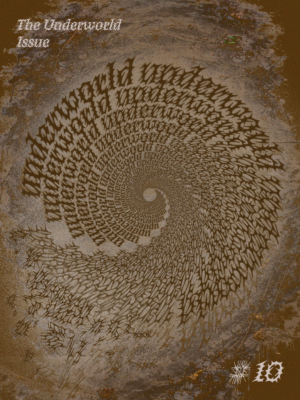
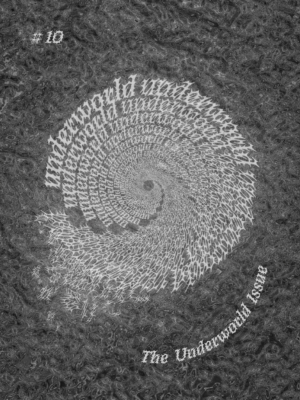
Issue #10 of Current Obsession unfolds under the working title Underworld. The issue departs from earlier investigations of surface, signature and sign – and moves, deliberately, downward.
Building on research initiated through Michel Foucault’s The Order of Things, Underworld is concerned with how worlds are organised before they are named, how knowledge is structured beneath consciousness and how bodies, materials and objects become sites where invisible logics surface.
Rather than treating the surface as something to be pierced or transcended, the issue approaches it as an active interface where internal forces register themselves materially. Skin, hair, ornament, muscle, ink, scars and residues function not as decoration or representation, but as systems of orientation. Adornment appears here as a cosmological and epistemic device, one that aligns bodies with social codes, spiritual orders, economies of power and geological time. Jewellery, in this context, is an agent that binds bodies to worlds, histories and infrastructures.
Underworld understands the body as permeable rather than autonomous. Knowledge is produced through contact, friction, pain, devotion, labour, exposure and repetition. Tattoos blur and migrate; metal presses against flesh; bodies train themselves into legibility; spirit enters through rhythm, song and ritual; identity coagulates or dissolves under the pressure of observation.
The underworld is entered not only through metaphor, but through muscle, skin, breath.
At a deeper stratum, the issue engages with subterranean cosmologies and ancestral knowledge systems that have survived precisely because they were marginalised, hidden or outlawed. Ritual adornment, mythic figures, protective objects and non-binary spiritual beings emerge as carriers of knowledge that exceeds colonial, patriarchal and rationalist frameworks. Instead of being a space of loss, the underworld is an ecosystem of memory and resilience, a tool for survival, regeneration and collective becoming.
Underworld also confronts the structural and material realities that underpin contemporary life. Extraction, filtration, decomposition and data flow link bodies to mines, servers, burial grounds and supply chains. Death appears not as spectacle, but as process, economy and logistics. Machines observe where humans can no longer endure; systems continue regardless of desire or consent.
At this depth, the human figure loses its centrality and becomes material among materials, subject to pressures of time, decay and transformation.
Throughout the issue, theory, fiction, interviews and visual material are placed in deliberate dialogue – sometimes reinforcing one another, sometimes contradicting, interrupting or refusing coherence. Underworld does not seek to make the hidden transparent, nor to translate all knowledge into language. Instead, it treats illegibility, decay and residue as productive states.
Become a Current Obsession I’M OBSESSED Subscriber to receive the magazine immediately after its release. Take a look at the available monthly or yearly subscription options.