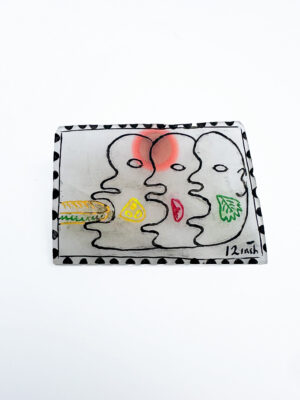
Floor Berkhout, a Dutch artist and researcher, thinks there is a way to define computing differently: ‘Like weaving, cooking, or organising, computation can be a tool for resistance and human connection. As the saying goes: those who program form worlds. It is time to own the skill to form our own.‘
Berkhout finished a bachelor’s degree in textile technologies, followed by a master’s in information design. Finding fashion too subjective, she turned to programming: ‘a practice where success isn’t dictated by opinion, but by the simple, objective truth of whether a system works or not,’ eventually finding common threads between the two. Discovering the historical and technical similarities solidified her interests, and she began researching both practices. born under thread is a love child of both fields, merging the wisdom that each provides.
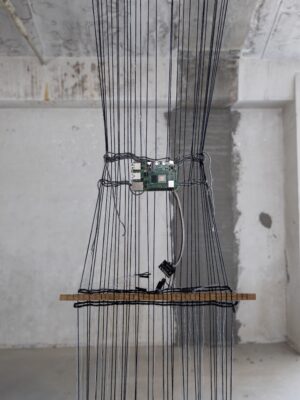
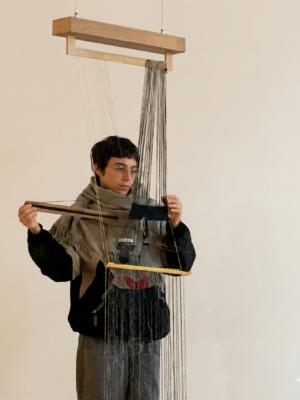
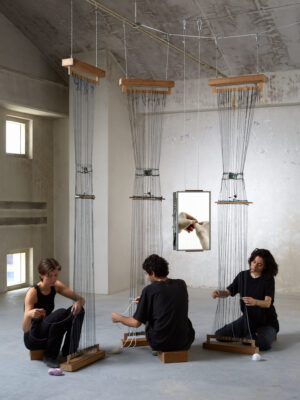
To fully comprehend the installation, it’s practical to understand a computer, as born under thread is, fundamentally, one. As Berkhout explained: ‘A computer is a device that takes in some form of input, performs a calculation or action, and produces an output.’ For Berkhout’s project, weaving looms function as the input: every touch is recorded and sent through a sensor to the CPU, here a device called Raspberry Pi. This unit, in turn, translates the touches into a 0 or a 1, which then allows it to identify patterns and understand when a weaving action is actually taking place. There are three looms, allowing three weavers to participate. Each generates a different outcome: a lone weaver can activate a data generation, which is displayed on the screen. Two weavers working on two looms prompt the computer to organise the data. Finally, when the third loom is activated, a pre-written background story is revealed to explain the purpose and history of the installation.
‘When we treat technology as magic, we lose the capacity to question, modify, or refuse it. You cannot hold a cloud responsible, but you can hold a machine operator responsible if you can see how they turn the gears.’
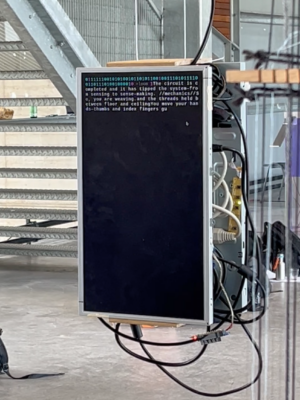
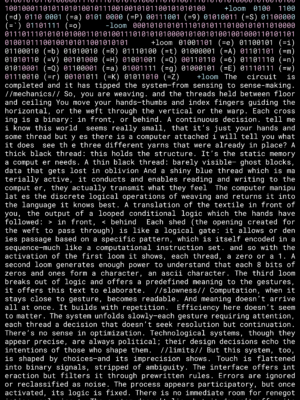
By implementing the traditional craft into the computation system, Floor Berkhout hopes to direct our attention to the current state of disconnect between ourselves and the devices to which we are inherently linked. Spellbound by the machine’s ever-increasing abilities, we tend to forget the physical reality behind the bright screens – the minerals mined from the earth, the electricity consumed, and the logic of the code. For born under thread, Berkhout inverts the meaning of autonomy: here, it refers to a human’s ability to intervene in the workings of the computer.
With the understanding of our primary tools decreasing, as a society, we can fall more easily into manipulation by tech-authoritarian structures. ‘For women and marginalised groups, this lack of autonomy is particularly pressing because the majority of these systems are not built with their safety or agency in mind. Therefore, crafting autonomy within rigid environments is an act of technological sovereignty and an act of feminism,’ Berkhout underlines.
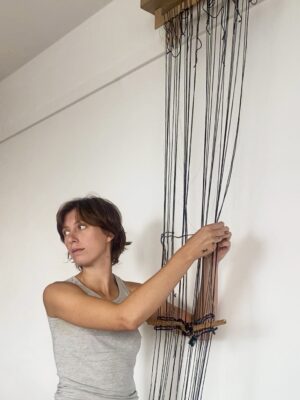
Berkhout believes, honouring one’s potential to understand the machine could shift our position from passive consumers to active creators, both dignifying and feeding our intelligence. All the while, it helps heal the sensory rift: ‘Modern computing creates a disconnect where we tap glass screens while the actual labour and environmental costs occur elsewhere. Bringing computation back to the level of human perception – making it something we can touch, be part of, and influence – reconnects the digital to the physical world. It serves as a reminder that the cloud is not a nebulous myth, but is instead made of wires, water, and many human hands.’
Moving forward, Berkhout plans to deconstruct the Western, individualistic logic of hyper-independence. Working with the concept of autonomy alerted her to the need to deepen this understanding, as well as to dismantle prevalent isolationism: ‘I want to explore how collectiveness is actually the essential ingredient for autonomy. My goal is to navigate the friction between independence and dependence, learning how to build systems where we rely on one another without losing our agency, and foster inclusivity without sacrificing protection.’ She wants non-white feminist thought to guide her work, yet recognises the struggle to apply it within a computational field shaped by whiteness and maleness. From a technical standpoint, Berkhout wants to build a ‘living communication protocol’, or an ‘Other Internet that functions more like a garden than a highway.’
Do you have a new collection or a new body of work that’s simply dazzling? We want to hear from you! And remember, there’s no deadline – we welcome submissions throughout the whole year!
Every submission is a potential gem, and our team takes great care in handpicking projects that resonate with the contemporary scene. To submit your work, just email high-resolution images (5-10 pcs), image credentials, social media tag, work description (max 250 words), and artist bio (max 250 words) to veronika@current-obsession.com.
Artist: Floor Berkhout
Website: https://materialprotocols.site/
All featured images are courtesy of the artist.
Floor Berkhout is a current resident at the Designer in Residence in Pforzheim.