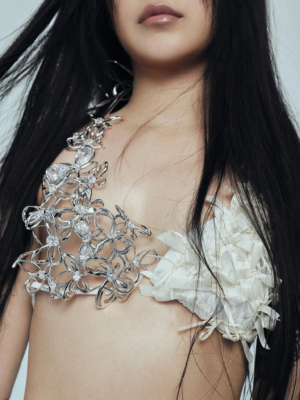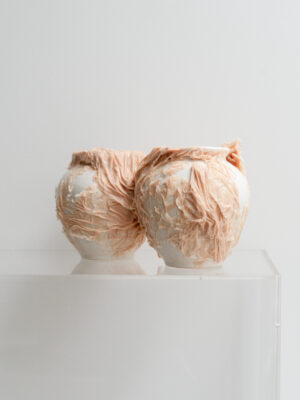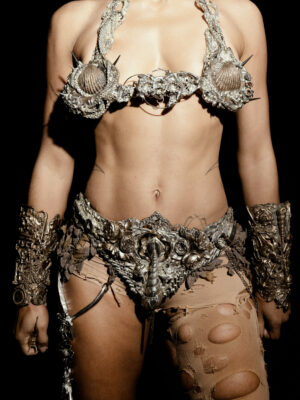
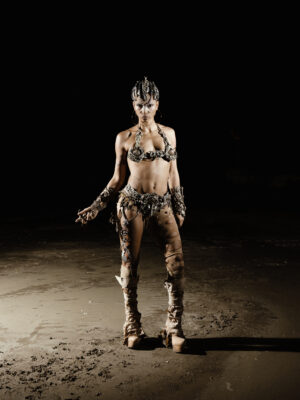
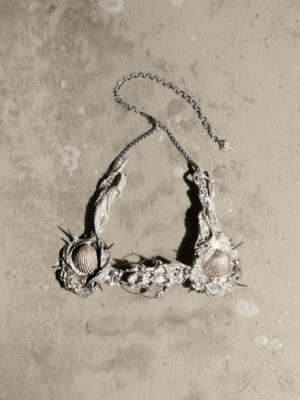
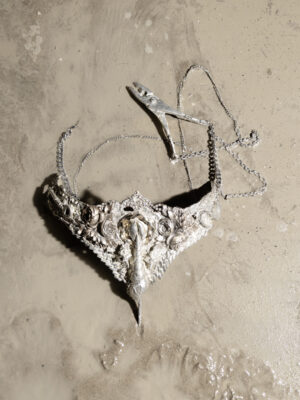
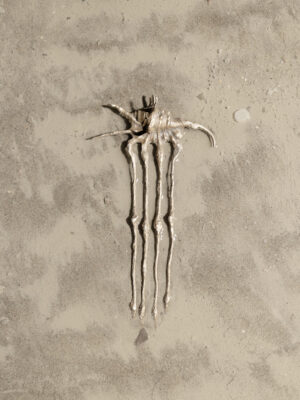
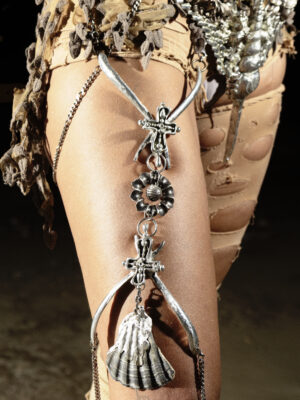
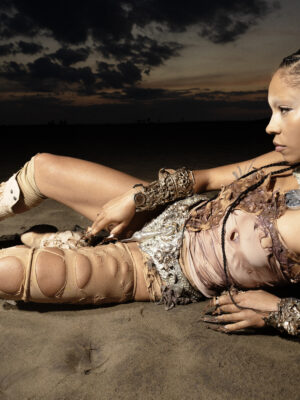
Though deceptively delicate at first glance, the metal wearables that comprise the ‘Relics of the Potomitan’ carry an edge to them. Expertly crafted from tin, a metal chosen especially for its lower melting point and plasticity, they incorporate found materials such as shells. Intricate and full of symbolism, Quitman’s work has an air of mystique, as if drawn from legends. Rightfully so – the collection is centred around the figure of the potomitan – an essential structural feature of a peristyle placed in front of a Haitian Vodou temple. For Alizée, that central pillar, one holding everything together, is embodied by her grandmother. In her work, she asks what happens to those who carry such weight on their shoulders for too long.
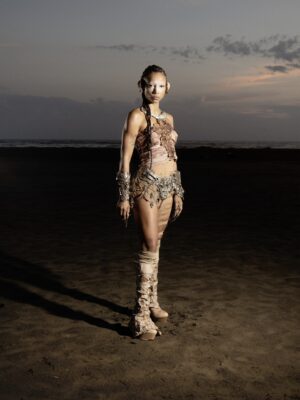
Regularly pushing boundaries of what’s possible within her craft, Quitman suggests that her fascination with a challenge may be connected to her Caribbean heritage and her upbringing as the daughter of a Caribbean military man. ‘I can think of at least three men who taught me different crafts while telling me that I would never manage to realise the idea I was presenting to them. And those moments always pushed me to prove them wrong – to show them: Yes, I can. I still carry that with me,’ she reflects.
A trained plastician, she merged her passion for mould-making, welding steel, fashion, and engraving techniques to create what became an internationally recognised artistic practice. Jewellery and wearable sculptures are not simply an aesthetic choice of artistic expression. The significance of ornamental wear reaches back to her cultural heritage: ‘In the Caribbean, an ornament is rarely simply decorative. It can carry identity, status, memory and history. Some symbols inherited from Caribbean culture also carry traces of colonialism and slavery: chains, créoles, references to bamboo and sugar cane.’ Quitman’s pieces may be beautiful, but she refuses to let them become just that. Rich in historically weighted symbolism, armed in strategically placed spikes and evoking uncomfortable truths, they are made to disobey.
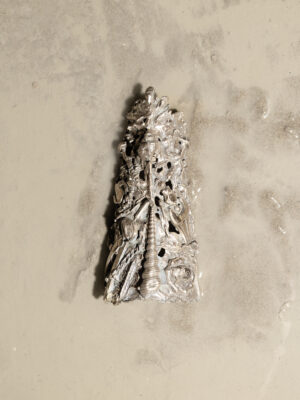
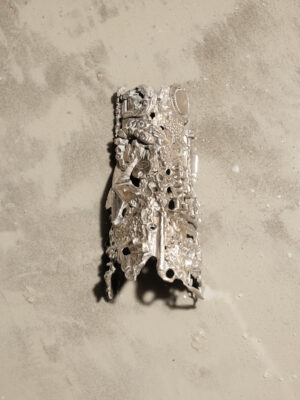
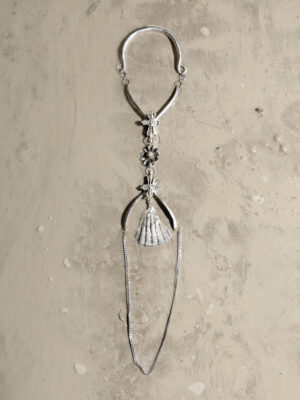
While aiming to reclaim the symbols of a history of violence and champion the strength of the people of the Caribbean, Alizée also embarks on a journey to unpick the concept of ‘femme potomitan’. ‘A femme potomitan is the strong woman, the woman who holds the family together, the central pillar of the home – literally a central post – someone who carries a weight on her shoulders that can be incomparable to everyone else in the family and in society,’ she explains. The heavy mental burden that comes from becoming femme potomitan or femme djok nearly erases the human being beneath the weight they carry, Quitman explains.
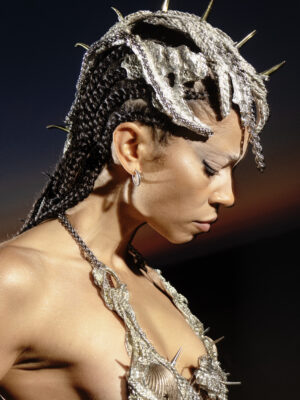
The collection begins with a female figure, but it does not end with her. Quitman sees the potomitan’s burden reflected in all those who carry the weight of a society that was not built with them in mind: racialised people, gender-nonconforming and non-binary people, disabled people, and anyone denied the space to express who they are. ‘I wonder what would happen if they were living their passion fully,’ she says, noting that some cannot even answer the question of what their passion is. ‘There is no space.’
‘I wonder what would happen if everyone were living their passion fully,’ Quitman says, noting that some cannot even answer the question of what their passion is. ‘There is no space.’
Unravelling the myth means looking at what lies beneath it. ‘It is important to demystify this image and try to look at the truth underneath it, to dust it off,’ she says. ‘Like the old tin pots.’ The comparison is more literal than it sounds. The tin she works with comes from reclaimed objects, collected from older people who are not always ready to part with them. Each exchange begins with conversation: Alizée shows her work, they talk, and what follows is, in her words, ‘a real relationship of transmission and transformation’. The material is then at the same time preserved and reimagined through the eyes of a young mixed-race woman, one who wants to honour the history held in an object while keeping the freedom to turn it into ‘a mediator for the present and future’.
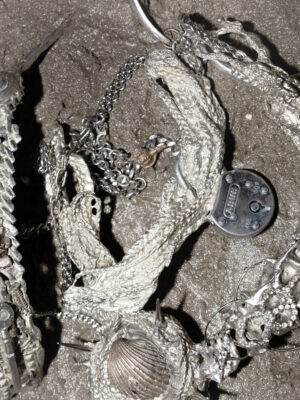
Like the tin, the shells that appear across the collection are found objects that carry a history of their own. An eager collector since her early years, Quitman incorporated them to speak of her ties to Martinique and the sea, but also of a territory scarred by chlordecone pollution and the proliferation of sargassum. Combined with chains, locks, wrenches and fragments of metal, they form a peculiar accumulation that sits somewhere between a fossil, a ruin and the remains of a submerged civilisation. The image echoes the myth of Drexciya, the imagined Black Atlantis where the descendants of the enslaved thrown overboard during the Middle Passage live on beneath the waves. ‘What was meant to disappear instead creates another world,’ she notes. The industrial objects echo natural forms: a screw can look like a shell, a wrench like a crab claw. The punk edge these tools bring works as a way of cancelling the image of jewellery as something nice, polished and soft, before softer, more organic elements pull the work back towards what she calls ‘a language of love’.
Created through fire, the metal carries the marks of its own transformation. I think of these pieces as fossils: objects that freeze a memory in matter while allowing it to move into another time.’
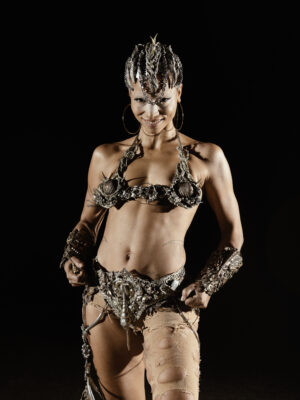
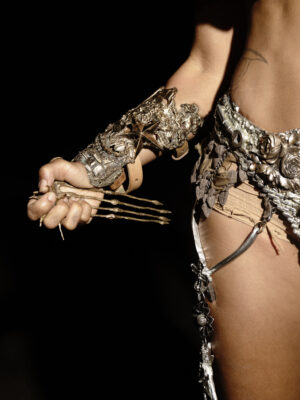
Together, the pieces build towards a complete suit of armour, which Quitman calls ‘A(r)mour’, made for an Afro-descendant heroine rising from the ruins towards a freer version of herself. It is not a monument to suffering, she underlines. The armour preserves the memory of what has been endured, but it is an object of transition, protection and becoming. It imagines someone who no longer exists only to carry a weight greater than she should have to: a person who can give and receive love, and who has the space to live with passion and freedom. For Quitman, the relic is therefore not simply a trace of the past but ‘the material evidence of a transformation’, of a person reclaiming their body, their voice and their right to exist as themselves.
Where the practice goes next is hard to predict. After three years as Head Jewellery Designer at Marine Serre, where she opened the jewellery department, Quitman feels herself drifting towards an artist’s practice rather than a commercial one. Yet she is wary of labels and keeps hold of the status of craftsperson, which she finds ‘increasingly meaningful today’. She does not rule out a return to luxury either, provided she can bring her own voice with her. Whatever shape it takes, she knows one thing for sure: ‘I genuinely manifest a life rooted in craft(wo)manship rather than AI.’
Artist: Alizée Quitman, IG: quality_zeeman
All featured images are courtesy of the artist.
Do you have a new collection or body of work that is simply dazzling? We want to hear from you! And remember, there is no deadline – we welcome submissions throughout the whole year!
Every submission is a potential gem, and our team takes great care in handpicking projects that resonate with the contemporary scene.
To submit your work, just fill in [this form], including high-resolution images (5–10 pcs in JPEG or PNG format), image credits, social media tags, work description (max 500 words), and artist bio (max 250 words).