The term itself is unstable, shaped by cultural expectations, social systems, and historical ideas of productivity, autonomy and beauty. Yet despite this instability, societies continue to privilege certain bodies over others – valuing wholeness, efficiency, and independence, while treating bodily difference as deficiency. The assumption that a body with all its limbs is somehow more complete, desirable or socially acceptable than one without them remains deeply embedded within dominant visual culture.
If we begin to think of the body not as a fixed form but as a space – a surface upon which meanings are produced – the role of dress and jewellery also shifts. They do not simply cover or adorn, but mediate: shaping how the body appears, and how it becomes legible to others. In Hungarian, the term for jewellery – kiegészítő – already inscribes a logic of supplementarity, where adornment is understood as that which completes or extends the body. Within this linguistic framing, ‘extension’ is never neutral, but always bound to an underlying idea of wholeness.
In this sense, prosthesis extends beyond its strictly medical definition. Rather than understanding it solely as a corrective device replacing a ‘missing’ function, prosthesis can also be understood as a reconfiguration of embodiment – something that redistributes the relationship between body, visibility, dependency and self-expression.
Exploring prosthesis inevitably raises a fundamental question: how can an artificial limb or an assistive device become an object of desire?
Rather than understanding it solely as a corrective device replacing a ‘missing’ function, prosthesis can also be understood as a reconfiguration of embodiment – something that redistributes the relationship between body, visibility, dependency, and self-expression.
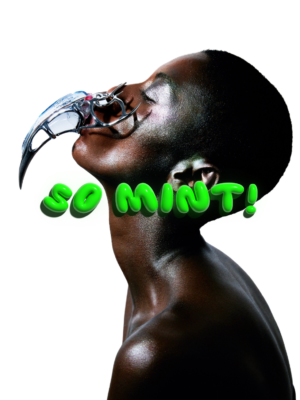
Jewellery brand YVMIN’s collaborations with Yang Jia and Wang Zhixuan transform assistive and bodily devices into sculptural forms that resist concealment. Rather than adopting the discreet aesthetics often associated with medical equipment, these works embrace the visual language of jewellery. For Yang Jia, instead of mimicking a normative leg, the prosthesis deliberately asserts its presence. Its polished metallic structure culminates in heart-shaped knee joints, balancing sharp industrial forms with playful, almost whimsical ornamentation.
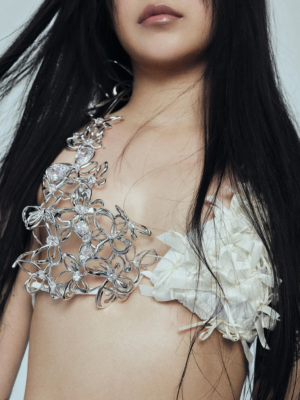
A breast’s absence can carry profound emotional and embodied consequences, particularly within a culture where femininity is often closely associated with the presence of breasts. The question of how to address this absence therefore remains complex: what possibilities exist beyond implants or conventional forms of reconstruction? Alongside the leg prosthesis, YVMIN also created a series of prosthetic breasts in collaboration with Wang Zhixuan, who was born with Poland Syndrome, resulting in the congenital absence of her right breast and pectoral muscle. Rather than seeking to conceal this difference, the collaboration reimagines the prosthetic breast as a sculptural jewellery piece – an object of adornment, expression, and self-definition. Through their lingerie-like softness and intimate femininity, these works reimagine prosthesis not as compensation for absence, but as an extension of bodily presence. In doing so, prosthetic legs and breasts become not merely acceptable, but deeply desirable, fundamentally shifting the meaning of prosthesis.
They function not only as forms of adornment, but as interventions into the ableist gaze itself. Yet these works speak to more than aesthetic transformation. They reveal that prostheses and adornments also shape the ways individuals experience and relate to their own bodies. The desire to feel attractive, confident, and visible is a deeply human experience – one that should not be denied to non-normative bodies. By transforming prosthetic devices into objects of beauty and personal expression, YVMIN challenges the assumption that assistive technologies exist only to compensate for loss; instead, they become sites through which wearers cultivate confidence, connection, and presence.
When getting dressed – selecting garments and jewellery to compose an appearance – prosthetic devices are often expected to disappear. They are concealed, neutralised or made to blend into the skin.
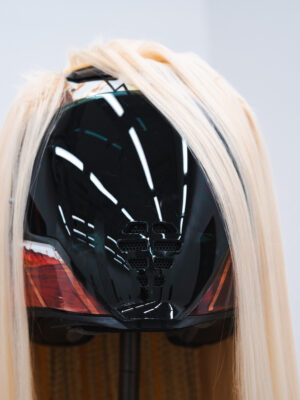
In 2023, our collective Dress-coding developed a project around hearing-aid jewellery in collaboration with jewellery designer Balázs Ágoston Kiss. Founded by fashion designer Fanni Huszár, the so-called hEarring project by Dress-coding emerged from a shared interest in questioning why medical devices are so often designed to disappear rather than to participate in personal expression. We opened a conversation around medical devices, shifting them from the realm of clinical utility into the language of dress and jewellery, where they operate as active components of aesthetic construction rather than invisible support systems.
The project unfolded through continuous exchange between Fanni, Emese, Balázs and myself, where design and terminology were treated as inseparable tools in shaping how medical objects are seen and understood.
Rather than disguising the device, we sought to emphasise it – to give it space to be seen, rather than reducing it to a skin-toned technical system. Instead of disappearing beneath hair or in flesh-coloured plastic, the jewellery frames the hearing aid, allowing it to occupy visual space with confidence. The final design emerged through a close collaboration between Balázs Ágoston Kiss and Noémi, a hearing-aid wearer who had previously avoided wearing her device. Rather than designing for her, the jewellery was developed with her, carefully shaped to sit comfortably on her ear while reflecting her own aesthetic preferences. In this way, the hearing aid became not an object to conceal, but an extension of her personal style and bodily identity. The metallic jewellery gently hugs her ear, drawing attention to the very part of her body she once wanted to hide but has since embraced.
In this way, the hearing aid became not an object to conceal, but an extension of her personal style and bodily identity. The metallic jewellery gently hugs her ear, drawing attention to the very part of her body she once wanted to hide but has since embraced.
Before making the finalised version with Noémi, conversations with other wearers revealed a striking tension: while many expressed interest in hearing-aid jewellery, they simultaneously preferred it to remain invisible, reflecting a deeply internalised association between visibility and stigma. This raises a critical question: when did these devices become something to conceal, rather than something that enables and extends the body?
This question gains further urgency in Panteha Abareshi’s practice, where concealment operates not only at the level of prosthetic objects, but as a broader social condition imposed on disabled bodies. As an Iranian-American interdisciplinary artist living with sickle cell beta thalassemia, Abareshi approaches disability not as an external subject, but as a lived condition. Her work draws on this embodied experience to examine the social, political and visual systems through which disability is made visible – or kept out of sight.
As Abareshi writes in one of her posts, ‘there is a painful cycling of containment… where one finds themselves relegated to the private, shadow-cast space’, expected to inhabit disability quietly and out of view. This dynamic extends beyond prosthetic devices themselves: it is not only assistive technologies that are concealed, but often the body as such.
In THIS IS NOT A BODY (2022), Abareshi foregrounds the ways in which disabled embodiment is mediated through its technological extensions, where prosthetic elements are never separate from the body, but always defined through their relation to it. The work unsettles the idea of prosthesis as an external supplement, instead exposing how bodily presence is constructed through systems of support and dependence, while simultaneously destabilising the viewer’s position through carefully orchestrated discomfort.
At first glance, the works in THIS IS NOT A BODY appear strikingly simple: wooden structures, medical devices and a quietness that feels almost suspended. Yet their apparent simplicity gives way to a deeply unsettling question: can we separate the body from a device upon which its survival depends? Although these elements are not a body in themselves and can exist independently, the work questions whether such separation is ever truly meaningful when these devices become inseparable from lived embodiment. If we accept the independence of these objects, why do we so often fail to recognise the autonomy and wholeness of the bodies that rely on them?
As Abareshi has framed, this discomfort is not incidental but intentional – a strategy to interrupt normative regimes of seeing and the ways in which disabled bodies are made legible through visual control. Visibility, in this sense, becomes a contested terrain, shaped by social expectations that equate difference with discomfort, and exposure with vulnerability. To design adornment that embraces, rather than disguises, non-normative bodies is therefore not merely an aesthetic gesture, but a proposition for presence.
By creating space for these bodies to be seen on their own terms, such practices do more than produce garments or jewellery; they enable forms of visibility, agency and psychological affirmation that have long been denied.
To engage with such bodies requires a shift from looking to seeing, as articulated by Rosemarie Garland-Thomson. Looking categorises, fixes, and distances; it sustains the fiction of the ‘normal’ body by measuring difference against it. Seeing, by contrast, is relational – it acknowledges the body not as an object to be assessed, but as a presence to be encountered. In this sense, prosthetic adornment does not simply invite attention; it demands a different mode of perception. Rather than concealing difference, it articulates it – transforming dependency, augmentation, and sensitivity into aesthetic and political forms. The question, then, is no longer how to normalise the body, but how to reconfigure the conditions under which it is seen. The notion of the ‘non-normative’ body obscures a more fundamental issue: it is not the body that requires correction, but the environment that frames it as such. When we design garments or jewellery, we are also designing the conditions of perception – actively participating in how the gaze is constructed and, potentially, transformed.
Taken together, these examples suggest that garments – and, by extension, jewellery – cannot be understood solely as objects that dress the body. Rather, they operate as mediating structures that organise perception itself, shaping the conditions under which bodies become legible, visible, or redefined. Understanding dress as prosthesis therefore extends beyond metaphor. It reframes clothing and adornment as infrastructural tools of perception – devices that actively participate in the construction of bodily meaning.
From this perspective, design is never neutral. It either reproduces dominant regimes of visibility or intervenes in them. To design with prosthetic thinking is to treat the body not as something to be corrected or completed, but as something already relational, already extended, already in negotiation with its environment. This shift opens up alternative understandings of what prosthesis, assistive technology, or even jewellery can be. No longer confined to correction or concealment, they become sites of articulation – where dependency, augmentation and sensitivity are not hidden, but made visible as conditions of embodiment.
Ultimately, this is not only an aesthetic question. It is a political one: about recognition, access and the right to appear without translation into normativity. The presence of non-normative bodies is non-negotiable.
Bibliography
Garland-Thomson, Rosemarie. “Feminist Disability Studies.” Signs, vol. 30, no. 2, Winter 2005, pp. 1557–1587. https://www.jstor.org/stable/10.1086/423352
i-D. “Yvmin: Experimental Jewelry Prosthetics.” https://i-d.co/article/yvmin-experimental-jewelry-prosthetics/
Liou, Caroline Ellen. The body is a bundle of chaos. Their art was designed to make you feel discomfort. Los Angeles Times, 2023. https://www.latimes.com/lifestyle/image/story/2023-03-01/panteha-abareshi-their-art-was-designed-to-make-you-feel-discomfort
Panteha Abareshi. https://www.panteha.com/
Panteha Abareshi Instagram posts. @pantehart
Vogue. “Yvmin: Chinese Jewelry Brand Prosthetics.” http://vogue.com/article/yvmin-chinese-jewelry-brand-prosthetics
Yvmin. “About.” https://yvmin.com/pages/about
Further reading list:
Barnard, Malcolm. Fashion Theory: A Reader. Routledge & CRC Press, 2020.
Benjamin, Walter. A műalkotás a technikai reprodukció korában. Open Books, 2024.
Davis, Fred. Fashion, Culture and Identity. Chicago: University of Chicago Press, 1992.
Entwistle, Joanne. The Fashioned Body. Fashion, Dress and Social Theory. 2nd ed., 2015.
Keszeg Anna. Divat-újratervezés. A kortárs divat médiaműködései, 2022.
Melkumova-Reynolds, Jana. “Let Me Be Your Stimy Toy”: Fashioning Disability, Cripping Fashion.” In Dangerous Bodies: New Global Perspectives on Fashion and Transgression, 2022.
Cover Image: YVMIN, 2023, Bikini Prosthetic Bra for Wang Zhixuan
All images were provided by the author, and we publish them in good faith; responsibility for rights and permissions rests with the author.
This year we’re diving deep, with Underworld as the main theme. We invite our writers to find beauty and (re)generative power in the decaying, slimy and grotesque, in the things that have been relegated to the ‘underworld’ but which are immensely life-giving. We welcome a range of writing anchored in research and distinctive points of view, including short-format essays, articles and interviews.
Guest edited by isabel wang pontoppidan, Danish-Chinese writer, artistic researcher and jewellery maker based in Amsterdam. Her practice is multi-pronged, combining writing, performance, research and jewellery in a variety of overlapping cross-sections.
In 2026, you can look forward to a new series of 12 articles released on a monthly basis, this time on the topic of the Underworld. Our articles remain open to all readers for one month from the date of publication and thereafter become part of the CO archive available to subscribers only.