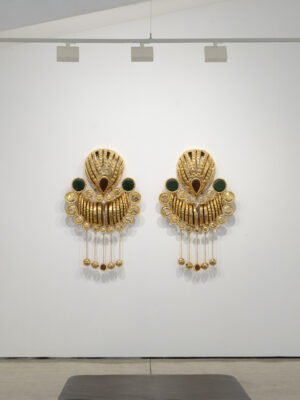
For me, an Asian mutt and waiguoren, something in the region of shame hangs over such items, disables them from use, alienates them from pleasure. Is it a fear of being judged for poor taste, which confers upon a Western-instilled guilt of coveting, of having? As much as I readily acknowledge that an unsatisfiable consumer impulse is one driver of planetary crisis, recognitions such as these feel theoretically over-styled, a way to accept and then admonish the existential drama of waste.
And so I became fascinated by the one spatio-temporal region that this dinner-party performativity could touch, that of the Chinese afterlife: where materialism turns de-materialisation, quite literally. Vendors nearby Buddhist-Taoist temples and cemeteries everywhere tout ‘ghost money’ and other paper combustibles plastered with the LV monogram – slippers, collared shirts, cash wallets – the burning of which allows these gifts to intravenously enter the stream of the spirit world. In my view, the brand’s success is wagered by being that much of a phenomenon: it not only bolsters the counterfeit market, but also has surfeit cultural currency to exceed the mortal realm.
‘But why’, I used to ask my grandma in my awful, grade-school Cantonese. Her abrupt departure in 2021 left one last hanging question: a Chinese funeral. Where was the mournful dark clothing; the mahogany casket; the severe, priestly speeches? The video clips sent by my two uncles in attendance, by contrast, featured explosively colourful everything and peals of tinny banging and wailing, and I peered at them through my dinky iPhone screen quite agog. For the occasion, the brigade of hired monks even burned paper people dressed as servants (they came with the funerary package) to dote on her in the afterlife – my grandma, who stashed money under her mattress and lived in a single-bed room among expired biscuits. It was like this that I grew to appreciate the tawdry whatnots, to respect the indubitable humanness of my ghost ancestors, to celebrate the ‘Chinese way’: a continuity of desire after death.
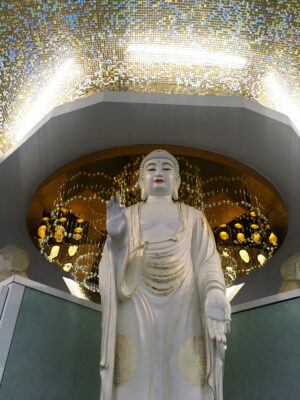
Back in the sloping heat of Singapore, where I’d lived through my teens, I did a jetlagged stroll of Google maps from my bed, tapping onto a place called Nirvana Memorial Garden, a columbarium on the west side of the island. My Cantonese grandma had recently died, so, in hindsight, it seems a pretty thinly veiled move to process expertly repressed grief. Death is an age-old artform and therefore, as in so many ancient cultures, the business of aesthetics and, being a curator, my business too. Or so I reasoned with myself, as I stood rooted to the building’s lobby, fingering a sales brochure, feeling that familiar need to ‘pass’. The business of death at Nirvana has some traits; these not only engender the crossings between realms but also the interpenetration of the body with design, and may be equipped to tell us something about a culture that understands a union between materialism’s two meanings.2
‘In lieu of debt from birth, why not the continuity of desire after death?’
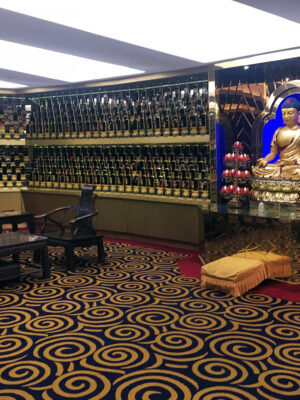
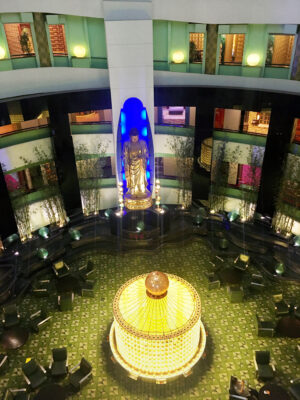
The austere, windowless exterior architecture suggests a spiritual stadium: turned inwards, the building is entirely preoccupied with what is happening on its inside. Upon entry, one sees the structure is organised according to the logic of an ascending, spiral ramp – a feature that sees visitors following the journey of the deceased, earth to sky. Spatially, the ramp also makes manifest two key, interrelated cosmological concepts: Nietzschean eternal recurrence on the one hand, and the circuitous exchange between heaven and earth on the other 3. Naturally, this is overseen by a monumental, gold-coated Buddha statue, the likeness of whom appears everywhere all over the columbarium with the reliable frequency of the monogram. As with the Singapore skyscrapers that grew like crystal clusters overnight, Nirvana is not only a product of modern idealisation but an apartment block for the upper echelons cast into the sky. It’s founded upon the one and same laws governing the real estate market, with differentially priced niches depending on, say, the suite’s placement in the building and the proximity of the ‘lot’ to the room’s Buddha or Guanyin statue 4.
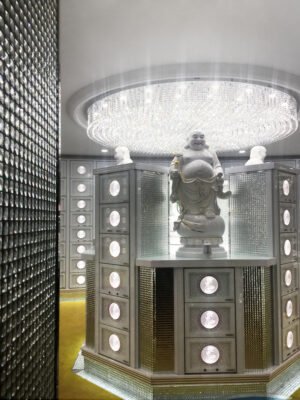
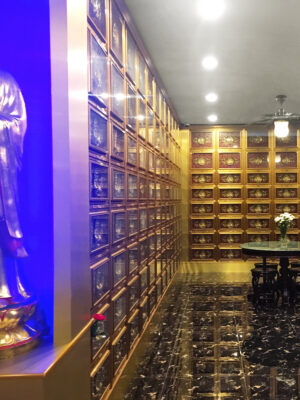
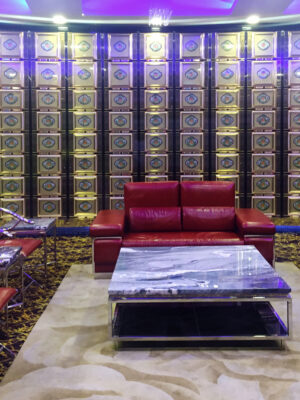
The stadium-fortress structure of Nirvana behaves as a protective sheath that deflects the hardships of the mortal world, all shiny surfaces devoured. Each room that splits off from the spiralling corridor is a vault of mirrors with hundreds of niches for stowing cremated re-mains: a miniature city of the dead emerging out of the practical necessity of burial space and indubitable land scarcity5. While these rooms vary in design (some are more traditionally outfitted to resemble a dynasty hall, while others remind of good times at the karaoke bar), their most pronounced, common feature is an endlessly bouncing light6.’ All is beiewelled, faux-crystal-studded sheen and sparkle: an exchange of shredded reflections that is all-seeing in its promise to vanquish shadow, turn out every crevice, leaving nothing untouched by its transcendental luminescence. Opulence at Nirvana functions in a way that is essentially Baroque: it leverages a complex, optical field of dizzying spectacle that overwhelms the senses and fragments the body to invoke the divine7.’
True it may be – Chinese culture has not undergone that which has brought about so-called aesthetic ‘sophistication’ in Europe. But something about the symbolisation of wealth in the afterlife incepted my thinking and turned it over. The blithe concealment of the desire for wealth is, at best, so bourgeois; at worst, it’s a type of virtue-signalling that old money loves to hold over new money – a threat-response and an insidious kind of class construction that, through superficial markers, only succeeds in differentiating wealth and wealth. When I awkwardly brandish the Louis Vuitton tote my mom bought but never used, I do so knowing I’m wearing her hard-earned dream. Though the idea of maximalism still intimidates me, the indefatigability of aspiration and its ability to extend into the far reaches of the afterlife is a bid to challenge personal attitudes I’ve yet to de-colonise. In lieu of debt from birth, why not the continuity of desire after death? In lieu of a holier-than-thou asceticism, better still, the felicitous Chinese abundance mentality that endlessly gives. Let’s not get it mixed up, as the golden goddess Donatella Versace once said, ‘Less… is really just less.’8
Footnotes
1 Definitions range, but all concede on the pejorative: ‘Kitsch is the German word for trash, and is used in English to describe particularly cheap, vulgar and sentimental forms of popular and commercial culture’ (Tate); ‘considered to be in poor taste because of excessive garishness’ (Oxford); ‘considered by many people to be ugly, without style, or false’ (Cambridge); emphasis my own.
2 Materialism as 1. the value system privileging material possessions that drives consumption under late capitalism; and 2. philosophically, the understanding of consciousness as issuing out of physical matter.
3 Nietzsche’s eternal recurrence as a life lived innumerable times chimes with the reincarnation concept of Chinese Buddhism that, along with the idea of Nirvana, was inherited from the religion’s arrival from northeastern India via the Silk Road, 1st century CE. See Friedrich Nietzsche, The Gay Science, trans. Walter Kaufmann, 1974, Penguin Random House USA Inc.
4 Though not exclusive to Nirvana Memorial, the columbarium’s pricing of ‘lots’ is premised upon things like the location of the ‘suite’ in the building and the proximity of the niche to a Buddha, with associated maintenance fees. See Nirvana Memorial, online: https://nirvanamemorial.com.sg/promotions/
5 You’re probably not worrying about fire regulations and how ming bi (ghost money) gets burned here, but of course, there’s a designated zone on the lower floor of the building ensuring visitors can still perform this tribute.
6 For Marx, as was then surely for Mao, fetishism blinds people to their exploited condition as alienated labourers. But with Nirvana as exemplar, the idea of being ‘blinded’ by material excess is put to other use. See Karl Marx, ‘The Fetishism of the Commodity and its Secret’, Capital: A Critique of Political Economy, vol. I, trans. Ben Fowkes, 1976, London: Penguin Classics / New Left Review, pp.164–65.
7 Self-identification turns de-individuation. The duplication upon duplication of the mirror image ad infinitum pushes the fold of recognition. Reflections fragment the body to such an extremity that the individual sees multiplicity in its stead: the infinite multiplicity of One. Lacan’s mirror stage involves a double twist tantamount to this reading; the reflection ‘recognition’ of the infant is in fact: ‘the méconnaissances [misrecognition] that constitute the ego, the illusion of autonomy to which it entrusts itself.’ See Jacques Lacan, ‘The Mirror Stage as Formative of the Function of the I as Revealed in Psychoanalytic Experience’, Ecrits, trans. Bruce Fink, 1997, New York: W. W. Norton, pp.3–9.
8 Thank you to Alex – my gorgeous queer, Spanish friend and seasoned maximalist – for this gem of a quip. Donatella Versace, as reportedly quoted in: Anders Christian Madsen, ‘versace’s reality check’, date unknown, i-D online: https://i-d.co/article/versaces-reality-check/
Cover Image:
All images were provided by the author, and we publish them in good faith; responsibility for rights and permissions rests with the author.
This year we’re diving deep, with Underworld as the main theme. We invite our writers to find beauty and (re)generative power in the decaying, slimy and grotesque, in the things that have been relegated to the ‘underworld’ but which are immensely life-giving. We welcome a range of writing anchored in research and distinctive points of view, including short-format essays, articles and interviews.
Guest edited by isabel wang pontoppidan, Danish-Chinese writer, artistic researcher and jewellery maker based in Amsterdam. Her practice is multi-pronged, combining writing, performance, research and jewellery in a variety of overlapping cross-sections.
In 2026, you can look forward to a new series of 12 articles released on a monthly basis, this time on the topic of the Underworld. Our articles remain open to all readers for one month from the date of publication and thereafter become part of the CO archive available to subscribers only.