Creativity – let’s call it inspiration – is strange, enigmatic. Songwriters often talk about melodies falling out of the sky; their job is simply to be there to catch them. Taken far enough, the question of where ideas come from becomes a question about free will, and the self: was that idea actually mine? And if so, where on earth did it come from? Making, as Karen Barad puts it, means meeting the universe halfway – the material always has its say. So when we investigate the habits and methods of makers, we’re really exploring psychoactive protocols: the rituals and routines that shift the mind into a different state. This year, Current Obsession’s Digital Publishing wants to understand how we create the environment in which new ideas can show up.
From friction and limitation to total freedom and transcendence, how do we nurture the fertile ground from which new ideas can flourish? How do we hold on to the research and development instincts of children – what the psychologist Alison Gopnik calls their lantern-like attention, their invented games – in our adult lives as makers? And in a world increasingly yoked to the impressions of a digital life, its infinite reference and its drift towards the middle, what are we doing to escape that bell curve? In this over-stimulated environment, is a state of boredom even possible anymore – a state that thinkers from Walter Benjamin onwards have seen as crucial to curiosity?
Is making a kind of training, akin to something athletic? Are we running drills, pushing at something, trying to break through? How important are failure and limits – perhaps ones to exceed – in broadening our creative landscape? We’re interested too, then, in the discipline, the repetition, the hardship! Does this suggest something physical as well as mental, the intelligence and intuition of the body? Haruki Murakami, who runs or swims every day while writing a novel, put it simply: ‘Physical strength is as necessary as artistic sensitivity.’
And what of the parts we can’t control? For centuries, people have handed decisions to something beyond themselves – drawing straws, the reading of cards, the chant, the trance. John Cage consulted the I Ching; Brian Eno drew Oblique Strategies cards – both, in their own ways, trying to get themselves out of the way. Why do we feel the need to bypass the finite self to reach the infinite – and how else might we do it? When we turn over a tarot card, why do we identify with it so readily, as if it had called us by name? In a talk at Cybernetic Serendipity: Towards AI at the ICA, the writer and artist K Allado-McDowell suggested that today’s algorithms do something similar, gathering us into patterns and handing us back to ourselves. Perhaps divination and the feed are closer than we think – and perhaps letting go of control on our own terms, making room for serendipity or even running towards it, is its own kind of method.
Some of these conditions we build alone; others we build together – in the choir, the apprenticeship, the shared studio, where knowledge lives between people rather than in one head. Whether it’s a ritual, a routine, a game, a drill or a roll of the dice, every maker builds some kind of sandbox: the conditions in which play, accident and failure are allowed to happen. This year we want to dig into those conditions wherever they’re found – in studios and workshops, on the track and in the laboratory, in the ancient and the algorithmic – and ask what it really takes to meet the universe halfway.
Here are four subthemes to help you dive into the theme and get your creative juices flowing:
• FAILURE: or how to make the most of the things that go wrong. When paths hit dead ends and results disappoint. We are interested in what happens next: that error that becomes a new method, a mistake that opens a door you never knew existed, or simply embracing the failure that teaches more than success ever could.
• CHANCE: the states that refuse to be tamed: chance, trance, divination, altered states. Let’s explore the moments when control is loosened or lost altogether: the roll of a dice, the reading of signs, the drift into a trance.
• SLOW: takes over when you need to zoom right in and slow right down: the body, repetition, craft. Not everyone yields to speed. This theme is about paying close attention: listening to your body’s innate knowledge or the pulse of repeated gestures.
• WITH: embraces the need for collaboration, contribution and community. Making space for more voices in the room and more hands on board. Relying on others to co-create an environment to nurture ideas.
To submit, please send us a compelling pitch of no more than 250 words via [the application form here]. The selected writers will be compensated according to the Dutch Fair Practice Code.
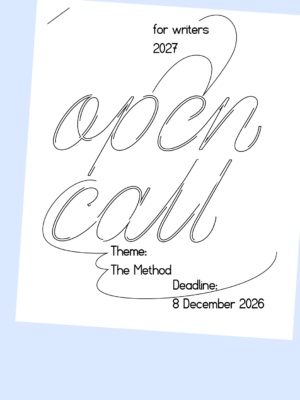
The deadline for submitting your pitch is 8 December 2026!
We welcome writing with depth and intimacy by both emerging and seasoned writers working within the broader fields of art, fashion and design. Pitch your 1500-word article idea by 8 December 2026 via the attached link under one of the subthemes.
Current Obsession Team