Contemporary Jewellery in Japan from Post-war Life to Living Memory
In conversation with Tomomi Miyagawa, curator at The National Museum of Modern Art, Kyoto.
edited by Margaret Munchheimer
October 15, 2026
Contemporary jewellery in Japan often seems to be framed as a late arrival to an already well-established, predominantly European narrative. Yet to approach it merely as a delayed echo would be to miss what makes the Japanese context both distinct and quietly radical. As the forthcoming exhibition Reflections in Jewellery: Memory and Identity (ジュエリーは、誰を夢みる) at the National Museum of Modern Art, Kyoto proposes, this is a story of translation, adaptation and an ongoing negotiation between body, material and everyday life.
As curator Tomomi Miyagawa emphasises, jewellery culture in Japan is relatively young. Prior to the Second World War, there was little social or functional demand for wearable jewellery as it is understood in Western contexts. The kimono, with its layered construction and textile-based ornamentation, left little room – or need – for necklaces or bracelets. Instead, Japan developed extraordinarily rich traditions in ceramics, lacquer, wood, metalwork and textiles, disciplines in which material intelligence and bodily sensitivity were already deeply embedded.
The emergence of jewellery after the war was therefore not driven by luxury or display, but by a desire to re-engage with life itself. In the 1950s, a generation of metal artists began to explore jewellery as a means of restoring intimacy and meaning to everyday experience in a society marked by loss and reconstruction. Rings, in particular, became quiet yet potent objects: made not for exhibition vitrines, but for daily wear. As one of the period’s key figures insisted, the question was not prestige, but whether an object could hold value within the rhythms of ordinary life.
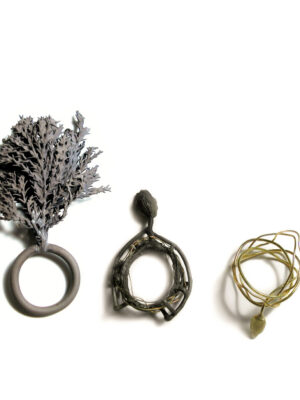
Ishikawa Mari, In the shade of the tree, rings, 2006
A decisive step in this shift came with the founding of the Japan Jewellery Designers Association(JJDA) in 1964. At a time when jewellery was still largely unfamiliar to the general public, the association functioned as a critical gateway. Between 1970 and 1986, it organised the International Jewellery Arts Exhibitions(later, Tokyo Triennial), first staged at Seibu Department Store in Shibuya. These exhibitions introduced Japanese audiences to work from Europe and North America and, crucially, reframed jewellery as design and artistic expression rather than a repository of precious materials. Early artist selection of these exhibitions appears to have benefited from the support of Graham Hughes and Dr. Fritz Falk. For it was under the leadership of figures such as Yasuhiko Hishida(菱田安彦, 1927–1981) and Yasuki Hiramatsu(平松保城, 1926–2012) that they began exhibiting overseas, starting at the Munich International Trade Fair in the very same year of their establishment, thereby building up their network of influential contacts.
‘Contemporary jewellery has mainly been examined from the perspective of Europe and North America,’ Miyagawa reflects. ‘In this exhibition, we weave another story – our story – by re-examining contemporary jewellery from the perspective of post-war Japan.’
Gradually, the 1980s marked a second turning point. Japan’s economic growth enabled structural changes in education and institutions, allowing jewellery to move beyond vocational training towards conceptual inquiry. Few figures were as influential in this transformation as Takahiko Mizuno(水野孝彦, b. 1939), founder of Hiko Mizuno College of Jewelry(est. 1966). By radically reshaping the curriculum, Mizuno positioned jewellery as something‘good for daily life(生活良品),’ It’s likely a play on words based on MUJI(無印良品), which was established around the same time – necessary for emotional wellbeing, and capable of expressing who a person is. Under his direction, the school became a site of international dialogue rather than mere skill transmission. Key figures in the evolution of the curriculum were Kazuhiro Ito(伊藤一廣, 1948–1997) and Kimiaki Kageyama(影山公章, b. 1948), who worked as teachers. For instance, Ito apparently first visited Otto Künzli and Therese Hilbert in 1977, the year he held a two-person exhibition at Electrum and participated in Schmuck 77 Tendenzen. He invited many overseas artists he had met in this way to the college, providing students with considerable inspiration through workshops. It is precisely under this influence that artists such as Mikiko Minewaki(嶺脇美貴子, b. 1967) grow as the next generation.
This ethos found its most tangible form in the Three Schools Project, initiated in 1993 as a collaboration between the Akademie der Bildenden Künste München, the Gerrit Rietveld Academie and Hiko Mizuno College in Tokyo, later joined by the Royal College of Art. As Miyagawa notes, this was not about importing European aesthetics wholesale, but about sustained encounters: artists travelling, working and thinking together. Jewellery became a shared language through which different cultural positions could be articulated, contested and reimagined. At the same time, this project served as a gateway to the international stage for young Japanese artists such as Jiro Kamata(鎌田治朗, b. 1978) and Mari Iwamoto(岩本万里, b. 1987).
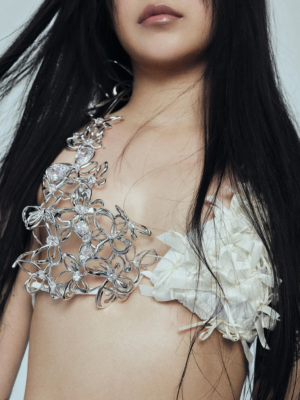
Minewaki Mikiko, Mike, necklace, 2017
A crucial historical anchor for the current exhibition is the landmark 1984 show Contemporary Jewellery: The Americas, Australia, Europe and Japan, held at the National Museum of Modern Art, Kyoto and curated by Shigeki Fukunaga(福永重樹, 1933–2001). Rather than organising work by national schools, Fukunaga presented jewellery as part of a broader field of material experimentation, aligning it with developments in ceramics and textiles. Artists such as Otto Künzli and Caroline Broadhead appeared not as representatives of Europe, but as participants in a global conversation about material and expression. The exhibition resulted in the acquisition of approximately 100 works, forming the foundation of one of Japan’s most significant institutional jewellery collections. It is from this collection, and from this layered history, that Reflections in Jewellery: Memory and Identity unfolds.
Structured in three chapters, the exhibition traces the introduction of contemporary jewellery to Japan from the 1950s to the 1970s, examines the period of expansion and international exchange from the 1980s to the early 2000s, and finally turns to contemporary Japanese artists whose practices are shaped by bodily awareness, memory, and transnational experience. Many of these artists have studied or exhibited abroad, yet their work resists easy categorisation within a Western canon. ‘Contemporary jewellery has mainly been examined from the perspective of Europe and North America,’ Miyagawa reflects.‘In this exhibition, we weave another story – our story – by re-examining contemporary jewellery from the perspective of post-war Japan.’ This insistence on authorship is key. Rather than positioning Japanese jewellery as peripheral, the exhibition proposes it as a distinct yet interconnected trajectory, one that places the body, daily life, and emotional resonance at its centre.
For our editorial team, this exhibition resonates deeply with ongoing questions around material culture, adornment, and the politics of visibility. It challenges entrenched hierarchies within jewellery history and invites a more plural understanding of how objects come to matter. In doing so, it not only revisits the past, but opens a space for future dialogues – between Japan and Europe, between institutions and independent platforms, and between jewellery as an object and jewellery as lived experience.
Reflections in Jewellery: Memory and Identity
The National Museum of Modern Art, Kyoto
24.10.2026 – 1.7.2027
Artists
Sigurd Persson, Mario Pinton, Reinhold Reiling, Bruno Martinazzi, Hiramatsu Yasuki, Hishida Yasuhiko, Herman Jünger, Yamada Reiko, Peter Skubic, Wendy Ramshaw, David Watkins, Gijis Bakker, Nakayama Aya, Bernhard Schobinger, Nagai Erico, Itoh Kazuhiro, Otto Künzli, Therese Hilbert, Caroline Broadhead, Daniel Kruger, Warwick Freeman, Sonobe Etsuko, Ted Noten, Karl Fritsch, Ishikawa Mari, Minewaki Mikiko, Felieke van der Least, Oyama Yuka, Taguchi Fumiki, Kamata Jiro, Juzu Kaori, Shinzato Akiko, and more than 70 other artists
Exhibition Design
Ryuji Nakamura (Ryuji Nakamura and Associates)
Graphic Design
Atsuki Kikuchi
Tomomi Miyagawa completed a master’s degree at Ochanomizu University in Tokyo in 2012 and subsequently continued into the PhD programme. The starting point of her research was the Mingei movement – a Japanese counterpart to the Arts and Crafts movement – reflecting a sustained interest in the social message of handcrafting.Her curatorial career began at the Museum of Oriental Ceramics, Osaka, followed by the National Museum of Modern Art, Kyoto, where she was responsible for the Crafts section. In Kyoto, the crafts category encompasses a particularly wide scope.
Cover image
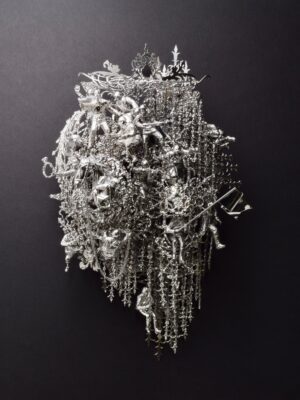
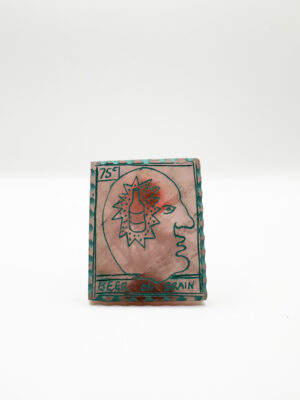
Taguchi Fumiki, The memory to relive, brooch and pendant, 2019