RUIN DRIVE

Permeable Body

Looking into the shiny, curved visor of a motorcycle helmet, I greet a slightly elongated reflection of myself. The humanoid creature in front of me has no face other than this; a distorted mirror of its opponent. I am the only person present, visiting the exhibition the day prior to its closing. Yet, I don’t feel quite alone.

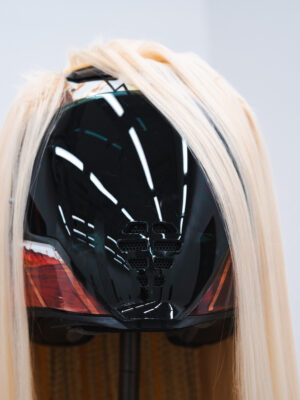
Three creatures stand like sentinels of a civilisation that has not yet collapsed in Margaret Abeshu Leversby’s Reality is Radical, held at Kunsthall Oslo in late 2025. Ruin Drive (black), Ruin Drive (blonde) and Ruin Drive (black, brown, red) share the same base structure and name, only differentiated by aesthetic variations such as hair colour, helmet design, and the particular angle of their stillness. Motorcycle helmets hug empty spaces perfectly fit for a human head. Artificial hair extends nothing except the idea of its aesthetic origin into coils of metal curled around the isolated wheel of a car. In the shiny, synthetic surfaces of metal alloys and fresh plastic, I see the warped reflections of different ideals for the extension of the human body. The helmet as a protective shell, the hair as adornment, the wheel as the instrument of spatio-temporal liberation. Without the body these extensions were made for, they become something else; a figure, an almost someone.

Overview of 'Ruin Drive' (black, brown, red) 'Ruin Drive' (black) and 'Ruin Drive' (blonde) in Margaret Abeshu Leversby • 'Reality is Radical' at Kunsthall Oslo • Image credits Kunsthall Oslo •

In Freudian terms, the Unheimlich (uncanny) is the dread produced by the almost human. Humanoid automata, waxwork figures, and eyeless faces inhabit the ambiguous shadowland between what is recognised as living bodies and what is not.1 This mysterious gap between strange and familiar bodies is what Japanese roboticist Masahiro Mori later came to call the uncanny valley, stating that ‘in climbing toward the goal of making robots appear like a human, our affinity for them increases until we come to a valley’.2 It is in this valley, just before convincing likeness, that recognition turns into repulsion. Here, the almost human robot exists alongside corpses and zombies. Figures the brain cannot decisively define as either human or inhuman; a third state of being that not only exists between man and machine, but between living and dead, object and subject. What is unsettling about this valley is not that its inhabitants are foreign to us, but that they are almost not. The horror is one of proximity, not distance.

‘Abeshu Leversby’s titling of Ruin Drive might in this sense be seen as a direct play with the Freudian term for the repressed longing for what is not just right; the being or object that fails to clear the threshold of the human by the smallest possible margin.’

For Freud, the creatures of the uncanny valley are also strangely alluring, evoking the ambivalent attraction towards what is unpleasurable; the death drive.3 Abeshu Leversby’s titling of Ruin Drive might in this sense be seen as a direct play with the Freudian term for the repressed longing for what is not just right; the being or object that fails to clear the threshold of the human by the smallest possible margin. Ruin here replaces death, indicating the material remains, instead of immaterial absence, of life. For Abeshu Leversby, the ruin is a working method. In a presentation held in relation to the exhibition, she states that ‘a ruin is neither fully past nor fully present. It marks the point where a construction has collapsed, but its structure is still standing.’4 I see the ruin drive as a death drive that goes beyond the human. A repressed force within structures towards collapse, within utopian ideals towards practical failure, within plastic towards trash, within life towards death. It is a drive inherent in all structures, material, ideological or emotional. Standing in front of the Ruin Drive figures, my drive is directed at them, while their drive is directed inwards. A metal rod spiralling around a wheel that doesn’t budge, driving towards stagnation. A drive towards a ruined state, and my drive towards this ruin.

'Ruin Drive' (black, brown, red) in Margaret Abeshu Leversby • 'Reality is Radical' at Kunsthall Oslo • Image credits Adrian Leversby •

Mark Fisher regards the ruin within his conceptions of the weird and the eerie, in an essay going ‘beyond the Unheimlich’.5 The weird is here found in encounters with ‘that which does not belong’, while the eerie relates to the feeling of finding ‘something present where there should be nothing’ or ‘nothing present where there should be something’.6 For Fisher, the eerie often resides in landscapes left marked by humans who are no longer present, making the observer ask fundamental questions of agency, such as ‘what happened to produce these ruins, this disappearance?’ and ‘what kind of entity was involved?’.7 Describing abandoned stone circles and bewildered eyes, Fisher illustrates how the appealing serenity of the eerie can ‘give access to the forces which govern mundane reality but which are ordinarily obscured’.8 Fisher names capital as one of these forces, producing effects while escaping our sensory apprehension.9 Shaping our realities while bearing no shape. These hidden forces are also at the core of Abeshu Leversby’s exhibition, which, in name, posits that reality is radical. The artist explains that ‘Everyday arrangements of work, care, housing and time are already charged with exhaustion and inequality, but also with obligation and possibility. We do not need to decorate reality with radical images; we need to let those arrangements be seen more clearly.’10 Mundane reality is revealed as radical, through the eerie presence of an absence. The ruin drive guides us towards this realisation.

Closeup of 'Ruin Drive' (black) in Margaret Abeshu Leversby • 'Reality is Radical' at Kunsthall Oslo • Image credits Adrian Leversby •
'Ruin Drive' (black) in Margaret Abeshu Leversby • 'Reality is Radical' at Kunsthall Oslo • Image credits Adrian Leversby •

The eerie evokes a tense serenity that also defines the ruin drive. A curious longing directed at nothing where there should be something – the empty space inside a helmet, indexical to the idea of a head it has never seen. It is a drive that resides in both object and subject, as they meet in the image of the ruin. The drive towards the ruin is a drive towards abandoned structures, dreams, ideas and hopes, greeting the eerie absence as something in itself. Not with a ‘soft melancholy’, Abeshu Leversby says, finishing her presentation. ‘How can I live with what remains without turning it into a relic? This project is, in many ways, an attempt to stay with the unfinished: to move among remnants of disillusion, promises and unexamined inheritance without converting them into emotional currency, and to ask instead what kinds of practice and responsibility are still possible in the aftermath.’11 Staying with the ruin, staying with what remains, staying with the eerie and asking what can be done in the humanoid vacuum between something and nothing.

‘How can I live with what remains without turning it into a relic? This project is, in many ways, an attempt to stay with the unfinished: to move among remnants of disillusion, promises and unexamined inheritance without converting them into emotional currency, and to ask instead what kinds of practice and responsibility are still possible in the aftermath.’

–Abeshu Leversby


Ruin Drive (black), Ruin Drive (blonde) and Ruin Drive (black, brown, red) are not yet ruined – too polished, too present, too precisely assembled, and have no drive – immobilised by the nature of their own structure. They exist in a third state, the exhibition seems to be proposing: a still-standing structure of a collapsed dream of agency. The ruins of an imagined drive, or the drive towards imagined ruins. It is here we find the almost human, the unliving that was never alive, yet cannot be fully separated from life. The wheel is stopped in motion, the hair does not blow in the wind. Yet the figure seems to so desperately wish for agency, movement, action, keeping its head held high in what my brain alternately recognises as either stoic heroism or pathetic stubbornness. It is so very almost human. Every part of it, and the way in which these parts are assembled, seem in close contact with a human that is not there materially, but present as a ghost in the machine, a past ideal for a future state, inhabiting the ruins of a failed promise, refusing resolution through the insistent absence of any organic, agentic life.

Closeup of 'Ruin Drive' (blonde) in Margaret Abeshu Leversby • 'Reality is Radical' at Kunsthall Oslo • Image credits Adrian Leversby •

The affinity between Freud’s automata, Mori’s robots and Abeshu Leversby’s Ruin Drive series lies in their anthropomorphic form and synthetic origins. Made in the image of man, yet recognisably inhuman, they cause the brain to oscillate between identification and alienation. Facing the Ruin Drive series, I encounter a difficulty in drawing the line between the body and its extensions. I can’t fully isolate the technical objects from the body intended to utilise them. Assembled entirely from human extensions, they imply a body without containing one. In the gentle slope of bent metal, I see a spine reaching towards a plastic skull, which must have been gently caressed by the hands that braided its synthetic hair. In name, Ruin Drive alludes to a collapsed structure, but in front of me, I see a perfectly poised figure, something so close to a life I know that this life in itself is held up for inspection. In which ways am I, and in which ways am I not, standing in front of a body?

Closeup of 'Ruin Drive' (black, brown, red) in Margaret Abeshu Leversby • 'Reality is Radical' at Kunsthall Oslo • Image credits Adrian Leversby •

The body that shaped them, that dreamed them into existence, that braided the synthetic hair, bent the metal and stopped the wheel, is not as absent as it first appears. It is everywhere in the construction, but simply no longer inside it. Bodily extensions made for art, protection and movement often outlast the body they were modelled after, indexing a living being without ever breathing life. Jewellery, weapons, and rusty old cars remain as alien objects in the landscapes we leave behind, partially immune to the unrelenting decomposition of organic materials. From metal alloys to plastic fibres, from bronze age spearheads to polyester hair, human-made materials are left buried in the rubble of organic decay, to be dug up and inspected as ruins, relics, or alternatively – remains.

Fresh plastic is future trash. New bodies are future corpses. These figures, assembled at the threshold between two states, stand as a portrait of the contemporary human condition, extended so far into its tools and technologies that its ruins bear a human shape. It is here I meet the eyeless gaze of a future ruin, and see nothing where there should be someone, and myself where there should be nothing.

Footnotes

1 S. Freud, The Uncanny, p. 123–161.
2 M. Mori, ‘THE UNCANNY VALLEY.’ in The Monster Theory Reader, p. 89.
3 M. Fisher, The Weird and the Eerie, p. 31.
4 M. A. Leversby, Unfinished text for presentation of Reality is Radical, 2025, p. 6.
5 M. Fisher, The Weird and the Eerie, p. 8.
6 M. Fisher, The Weird and the Eerie, p. 61.
7 M. Fisher, The Weird and the Eerie, p. 11.
8 M. Fisher, The Weird and the Eerie, p. 13.
9 M. Fisher, The Weird and the Eerie, p. 64.
10 M. A. Leversby, Unfinished text for presentation of Reality is Radical, 2025, p. 1.
11 M. A. Leversby, Unfinished text for presentation of Reality is Radical, 2025, p. 7.

Bibliography

Fisher, M., The Weird and the Eerie, Repeater Books, 2016.
Freud, S., The Uncanny, translated by David McClintock with an introduction by Hugh Haughton, Penguin Books, 2003.
Leversby, M. A., Unfinished text for presentation of Reality is Radical, 2025.
Mori, M., ‘The Uncanny Valley’ in The Monster Theory Reader, edited by Jeffrey Andrew Weinstock, University of Minnesota Press, 2020, p. 89–94.
Ingrid Smevåg Gundersen is a Norwegian writer currently pursuing a Bachelor’s degree in Aesthetics, Art and Society at the University of Oslo (UiO). Previously an editor and writer of the art history publication Paragone, she currently works theoretically and creatively at the intersection between art, philosophy, technology and sound.  


Cover Image: Closeup of Ruin Drive (blonde) in Margaret Abeshu Leversby, Reality is Radical at Kunsthall Oslo, image credits Adrian Leversby


All images were provided by the author, and we publish them in good faith; responsibility for rights and permissions rests with the author.


This year we’re diving deep, with Underworld as the main theme. We invite our writers to find beauty and (re)generative power in the decaying, slimy and grotesque, in the things that have been relegated to the ‘underworld’ but which are immensely life-giving. We welcome a range of writing anchored in research and distinctive points of view, including short-format essays, articles and interviews.


Guest edited by isabel wang pontoppidan, Danish-Chinese writer, artistic researcher and jewellery maker based in Amsterdam. Her practice is multi-pronged, combining writing, performance, research and jewellery in a variety of overlapping cross-sections.


In 2026, you can look forward to a new series of 12 articles released on a monthly basis, this time on the topic of the Underworld. Our articles remain open to all readers for one month from the date of publication and thereafter become part of the CO archive available to subscribers only.