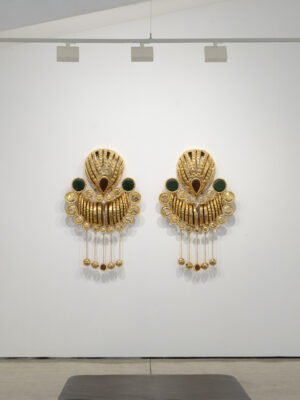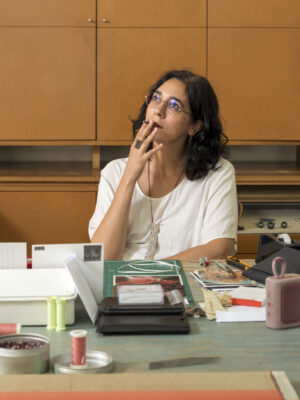
As we speak, she admits that the fantasy world within her is where she likes to be the most, connecting to her spirituality and spending hours with stories of love, care and desire materialised through the language of jewellery.
Yet, you shouldn’t be mistaken to think of a lonely artist working in the solitude of a pristine studio. On the contrary, community is an essential fuel for Catarina’s artistic practice. After graduation, she followed her former teacher Tereza Seabra to her gallery, where she has worked and co-organised exhibitions ever since.
As Lisbon gears up for the Contemporary Jewellery Biennial this September, Tereza Seabra Gallery will host Catarina Silva’s upcoming solo exhibition Jardin d’agrément, exploring the idyllic concept of the Paradise Garden. Beyond Catarina’s authorial work, she is instrumental in shaping the biennial itself, coordinating the International Schools Exhibition at Ar.Co and hosting seven international academies all responding to the theme of Coexistences.
Current Obsession: Catarina, as we speak you are sitting in the studio preparing for your solo show at Tereza Seabra Gallery during the upcoming Lisbon Contemporary Jewellery Biennial (LCJB). Could you give us a little sneak peek of what you are currently working on?
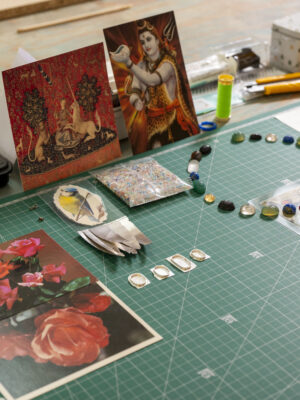
Catarina Silva: I’m making a completely new body of work for this exhibition, working around the idea of a Paradise Garden as an idyllic place where animals, plants and humans can live together happily ever after. It responds to the Biennial’s theme Coexistences but also fits my interest. I didn’t want to do something that has nothing to do with my subject matter in general.
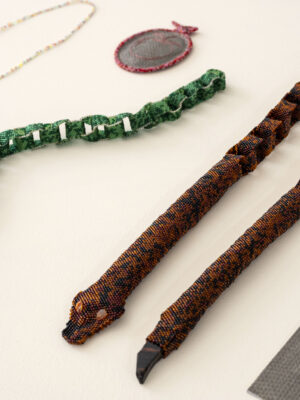
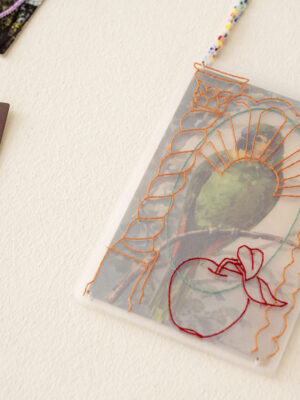
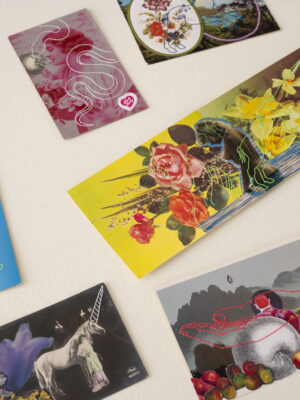
Since there is always a humorous side to my work, this Paradise Garden won’t be too serious. My idea of a paradise is that it is a fun and lush place to be. I work with many nature-related motifs – snakes and unicorns will be the two lead characters in this garden. It is the inseparable part of every Paradise Garden, the snake that comes to ruin everything, representing our temptation to always put responsibility onto others, and the unicorn, more subtle, related to the magical, strength and the purity of the spirits.
Jardin d’agrément proposes paradise not as a destination to be recovered, but as a poetic fiction: a flourishing world where every living being participates in a fragile, shared harmony, and where jewellery becomes a vessel for imagining new relationships between humanity, nature and the sacred.
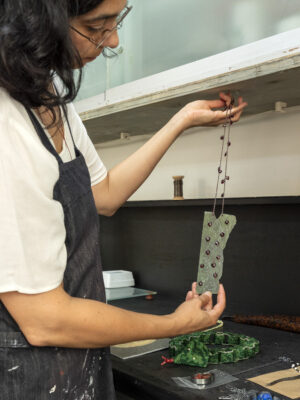
CO: Tereza Seabra Gallery is also where your studio is located and where you have worked since 2013. How did that come about?
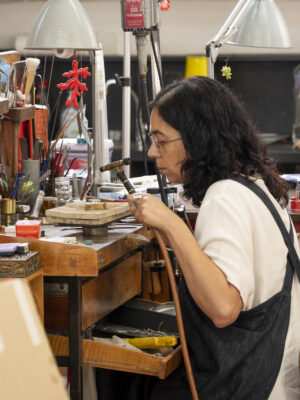
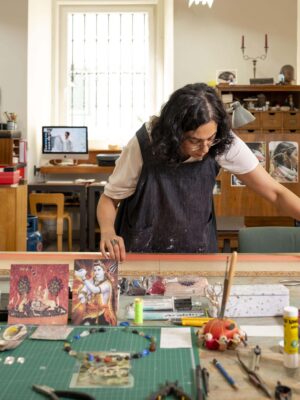
CS: Tereza was my teacher. I was in the last group of students of hers. I was always connected to the gallery because she has represented me since graduation in 2005, and in 2013, when one of the spots in the gallery freed up, I proposed to her to hire me as an assistant. At that time, I had been divorced for one year, and I was in this strange middle place. I had a very small studio on the fourth floor of a building that I had to turn into my apartment. It was very confusing for me because I was neither in my house nor in my studio, so this opportunity came at just the right time!
Even though we weren’t really close with Tereza before, coming there really made me want to put some dynamics into the gallery. I am like that when I go and work somewhere – I want to do something. I do not want to just be there. A short time after, I was already planning the exhibitions together with Tereza, being an active part in everything and every decision. It was also very good to grow here in the gallery in that sense: curating, choosing the artists and having ideas for the exhibitions. She has always been very open to my proposals.
CO: Is that also how you grew your network and gained curatorial experience, something that you currently also do as part of the LCJB organisation team?
CS: Yes. I really wanted to be involved and to be a part of it. It has been a very good experience. Of course, you always have this kind of strange situation, at least in the beginning, because you are working in a space that is open to the public and tourists, so you can never completely hide what you are doing. People come in and make comments on what you are working on, which surprised me because I have never asked, but nowadays I am completely used to it.
CO: I like what you said about yourself, that you are a person who needs to do something. Thinking that you have been the head of the jewellery department at Ar.Co for more than a decade, that is a very essential drive to have.
CS: Absolutely. The same thing happened at Ar.Co when Manuel Castro Caldas invited me in 2015 to be the head of the jewellery department. I was not expecting it at all – I was far from imagining that. I was a guest lecturer every now and then and gave some workshops, but that was it. I remember it was on a Saturday. He called me while I was working at the gallery. We stayed on the phone for an hour talking and at the end of the conversation, I asked him, ‘Manuel, do not take me wrong, I am very thankful – but are you sure I am the one for the job?’ He laughed and said, ‘Well, I am not sure, but I guess we will have to see. Think about it, give it two or three days, and call me back.’
CO: And now you have been teaching for more than ten years?
CS: Yes, and I love teaching! I like the coordinating part as well. Before I answered Manuel, I spoke with a very good friend of mine who works as a diplomat. She said something really important to me. She asked me, ‘Catarina, you have to decide if you want to command a team or if you want to coordinate a team, because it is not the same thing.’ I replied that I did not want to command anything, but I can imagine coordinating. She told me to say yes to the job.
CO: Important words of encouragement.
CS: Yeah, I like to work in a group. It is just like with Tereza – I like to discuss and share ideas. What I really love is to create a community – I think that’s really important. Sometime ago, Manuel, the director of the school, told me that the jewellery department is the only one where there is always someone working. He said that in the sense that I really succeeded at creating a community. People like to be there, be in a group, work and share. I think that’s really important when you are teaching, to create that sort of environment.
‘I see my ability to make things with my hands as a gift, and the only way to honour it is to use it. This is my mission in this life.’
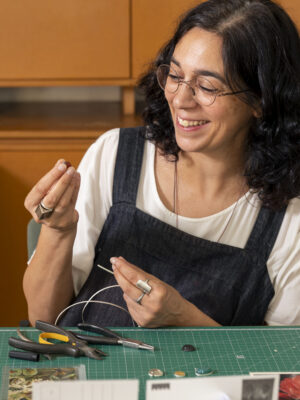
CO: This is the feeling that we also got when we visited the Lisbon Contemporary Jewellery Biennial in 2024. Everything revolves around the community. It is not just that it is organised by a group of makers with different perspectives, but also how everybody follows and engages in the events and activities. Compared to other festivals, Lisbon has this aura of doing and experiencing things together in a very relaxed atmosphere.
CS: I believe it’s a cultural thing. The cultural background of a country moulds the way people live in the community. The fact that this is a Christian country with a traditional cultural background has a lot to do with the community, being together and sharing. I think that sharing is so, so important, especially nowadays when people are more and more closed in their small, digital, individualistic worlds. I do not think that brings any advantage to anyone. So, I decided to be a sharing person.
CO: Speaking of cultural heritage and traditions, one of the techniques you work with is beading. I wonder, is there a strong tradition of different handwork and craft in Portugal which women practise together and pass on to each other?
CS: Well, yes, there is. It’s very common. Actually, I’m taking part in a workshop here in the neighbourhood of the Tereza Seabra Gallery in Brotéria. It is a cultural space run by the Jesuit community, and they are holding an embroidery workshop with migrant women. It’s nice because their idea is that they share knowledge about their traditional knitting and needlepoint, but we also share with them what we know, in a group of older ladies that talk a lot [laugh]. I think that this is something I really miss in society. I know sometimes I can sound conservative saying these things, but I do not mean it in a conservative way. In the past, when women would stay together at home embroidering or drawing, it became a group activity where they shared their personal stories and created bonds.
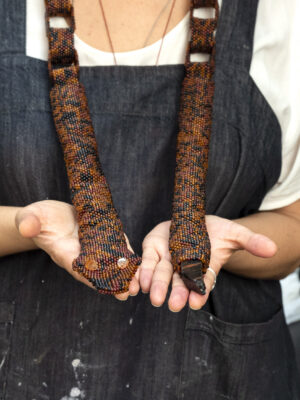
That is also a reason why almost every year I teach beading techniques to the students at Ar.Co. I really like that moment of the year when we are all seated at the big table together and even though it is a course and I’m teaching, we are also making, talking and sharing stories. That is something I think society misses a lot because, again, that brings community and trust between people.
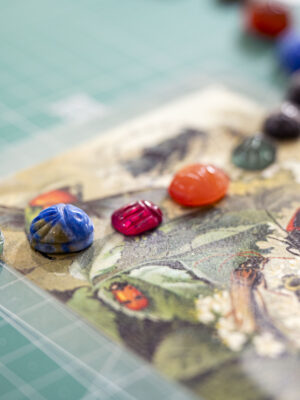
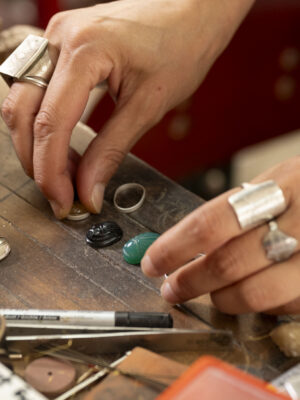
CO: When one looks at your work, they can see this link. Your solo show is basically entering and experiencing a lush Paradise Garden, a site-specific installation that has a lot to do with your core interests like community, memories, mythology and rituals.
CS: I think I have two sides to my work that are connected because they came directly from within me. There is this side of spirituality and working with rituals. I’m a spiritual person. I practise my spirituality and that is an important part of my way of being in this life. There is also the subject matter of love. I’m a romantic, which is not always good, but it is what it is. [laugh] Romantic love and spiritual love are subjects that my work gravitates towards.
My therapist once asked me something I was angry about until later when I understood: ‘Catarina, why do you have so much difficulty living in reality?’ And the truth is, reality is not fun at all for me. I am an artist – of course, I don’t live in reality.
I have always had this fantastical, mythical interior that was a very important part of my work. That still continues – even in the new semantics I work with now – there is always a lot of fantasy. In 2019, when I started to work a lot with beads, that part of the spirituality became much stronger. With the confinement, it was a really important thing that appeared in my life. The fact that you are obliged to stop and live in a more natural rhythm of life had a strong effect on me. My work became more about spirituality, love and caring.
CO: Which also responds to the technique of beading itself as a very repetitive and meditative process…
CS: Exactly. But more so, it’s very important for me to create. Ever since I can remember, I always knew I was an artist. It’s not a decision I made, but an intuitive drive. I’ve always had this will to work, to do. I don’t need an exhibition to create – I’m always doing things regardless. It’s a fun and existential thing. I need it. All the things that happen to me translate into the work.
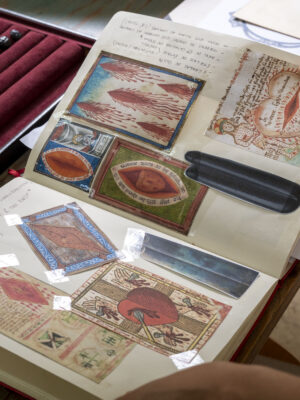
CO: Saying that you were always an artist, you must have started early. Were you a crafty child?
CS: The things I liked to do were always three-dimensional. I remember I enjoyed to do collage and build small things as a child.
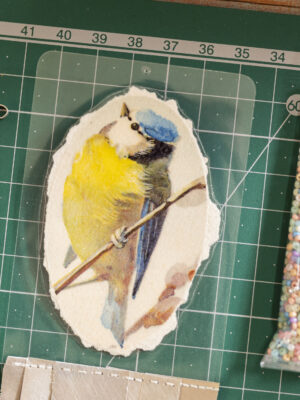
My first memory of making jewellery is from school when I was small kid, around four years old. I remember spending hours by this paper Ligustrum tree with a very tiny paper leaves. If you pulled them carefully, they came off whole with a hole that you could string together. I remember picking them and stringing them for hours. I have always enjoyed these very slow and repetitive processes.
CO: It sounds like you found your true calling in life through the work you do and your practice.
CS: Yes. I believe I’m a lucky person because I have never been afraid to show who I am. Even when I suffered serious bullying at school, I never tried to be someone else to please the bullies. I can’t bend to anyone else’s will. I see my ability to make things with my hands as a gift, and the only way to honour it is to use it. This is my mission in this life.
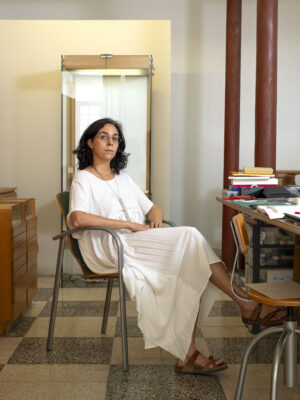
All featured images are the courtesy of the artist and photographer Eduardo Sousa Ribeiro.
For more information about the exhibition Coexistences: Schools at Ar.Co, curated by Catarina Silva, click here, and for details on her solo exhibition at Tereza Seabra Gallery alongside other exhibition openings, click here.