Cindy (Xinyi) Wu is a Chinese-born, London-based jewellery designer whose practice treats jewellery as wearable sculpture in dialogue with the body, emotion and narrative. She graduated with a BA in Jewellery Design from Central Saint Martins and an MA in Jewellery & Metal from the Royal College of Art. Having previously studied visual arts in the United States, she brings an interdisciplinary perspective to her work.
Combining traditional craftsmanship with experimental making, Wu challenges conventional ideas of adornment through innovative materials and established jewellery techniques. Her work explores the relationship between material, form and bodily experience, creating pieces that are sculptural, tactile and conceptually driven.
Her work has been exhibited internationally, including at Munich Jewellery Week; London Design Festival; the Puyuan International Contemporary Jewellery Art and Design Biennale; and the National Museum of Decorative Arts and the Museo Cerralbo in Madrid. Her projects have been featured by publications such as Dezeen, China Gems and Harper’s Bazaar.
Current Obsession: Could you tell us the story behind your graduation project and what drew you to the subject?
Cindy Xinyi Wu: This series explores small, familiar moments when control begins to slip. It is developed through three moments: Almost Balanced, Almost Open and Almost Set.
Each moment starts from an ordinary action – taking, pulling or setting – but the expected result becomes uncertain. A structure may collapse, a tool may fail, or a precise making process may turn into pressure.
Coming from my own discomfort with losing control, the series turns these moments into jewellery, objects and short films. Through these forms, the works explore this fragile state and stay with it for a while, allowing tension, frustration and humour to exist together.
Moment 1: Almost Balanced
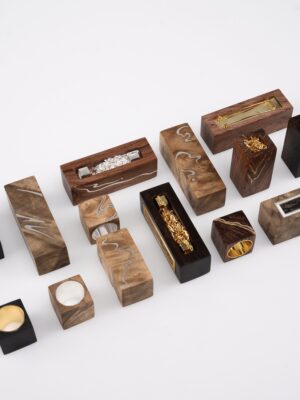
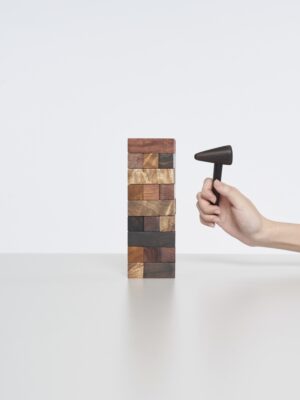
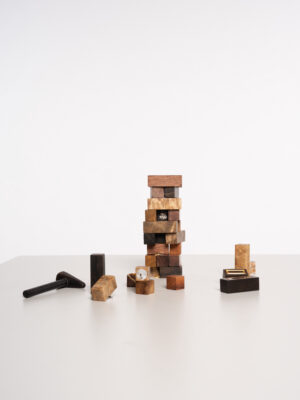
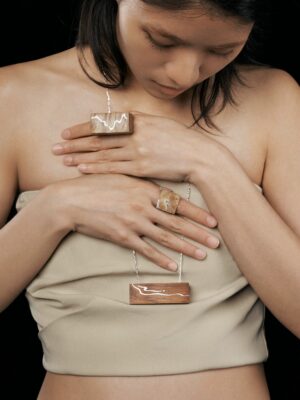
Wearable pieces are hidden within a wooden block structure inspired by Jenga. To take one, the participant has to find it and carefully pull it out.
This action creates a moment of dangerous balance: the structure is still standing, but any movement may make it lose balance, allowing the participant to physically feel control slipping away.
Moment 2: Almost Open
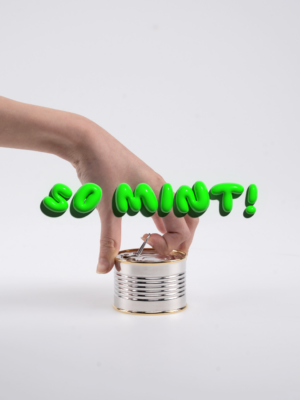
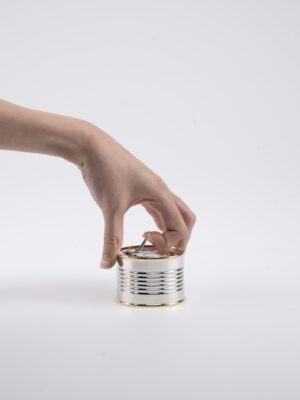
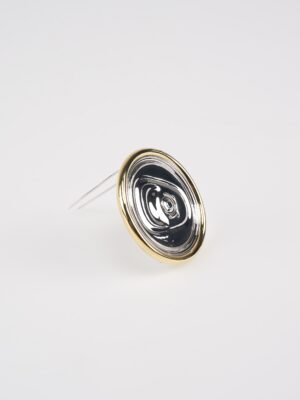
This moment focuses on a small everyday failure: the can pull tab, a familiar tool that usually feels simple and controllable, suddenly loses its function.
In one object, rubber replaces part of the metal pull tab. It stretches under the hand but cannot open the lid.
The brooch comes from the frustrating moment when the tab breaks off, leaving a sealed lid that can no longer be opened.
Moment 3: Almost Set
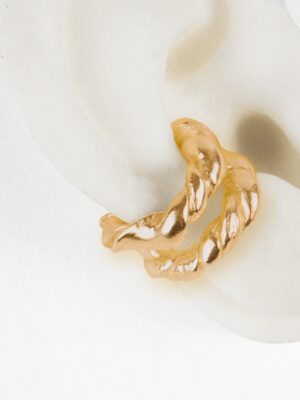
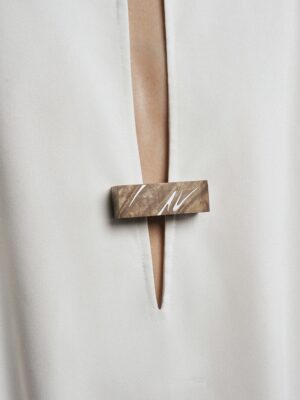
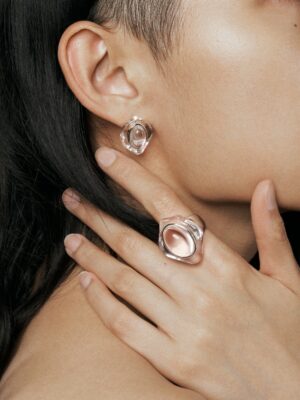
This moment comes from a familiar frustration in jewellery making: after carefully making a bezel setting, it turns out to be slightly too small, and the cabochon cannot fit.
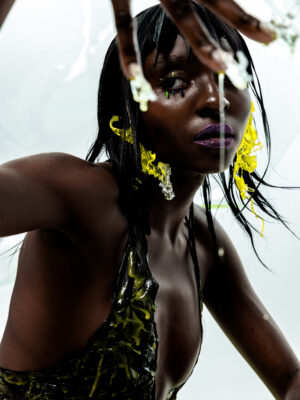
Through exaggeration and surreal humour, the stone appears to burst open under pressure, almost like an egg yolk.
The work freezes the moment when precision turns into absurd pressure.
CO: Beyond the gallery, where do you see your work taking root and finding its life? Who do you hope to reach with your work?
CXW: Beyond the gallery, I see my work taking root on the body, in everyday encounters and through shared feelings of frustration, tension and humour. The project begins with small moments of losing control, but these moments are not only personal. They are familiar experiences that many people recognise: a tool failing, a structure becoming unstable, or something refusing to fit.
I hope the work can reach both contemporary jewellery audiences and people outside the field. By turning fear and frustration into wearable objects, situations and images, the work offers a different way to stay with these uncomfortable moments – not by softening them completely, but by allowing humour and absurdity to sit alongside them.
CO: What’s your favourite studio ritual?
CXW: Before I encountered contemporary jewellery, I was afraid of losing control. I wanted things to be planned, precise and predictable. But contemporary jewellery gradually opened up another way of making for me. It allowed me to question that instinct, rather than always trying to protect it. In the studio, I often choose a material, process or direction that feels unfamiliar, unstable or slightly uncomfortable, and then stay with it through repeated testing.
This approach has appeared across my practice. In my previous project Rising, I used bread as the main material. The dough was soft, alive and difficult to command; it expanded, changed shape and resisted precision. Instead of forcing it into a fixed result, I had to observe it, wait for it and work with its behaviour.
In Almost Under Control, this way of working continues; I keep returning to moments where control feels uncertain, then explore them through different materials, actions and forms. The process usually involves adjusting, failing, remaking and slowly understanding what the material or structure is trying to do.
So my studio ritual is not one repeated gesture, but a repeated attitude: moving towards the things I am afraid of losing control over, and allowing them to become part of how I think and make.