SUBMERGED LINEAGES

Rae-Yen Song 宋瑞渊 •~TUA~• 大眼 •~MAK~• and the Ecology of Ancestral Becoming

Rae-Yen Song’s •~TUA~• 大眼 •~MAK~•, presented as a solo exhibition at Tramway, is the artist’s largest and most ambitious endeavour to date, transforming the vast gallery into a submerged cosmology that is at once sculptural installation, living ecosystem, and ceremonial site.

Conceived as a newly commissioned body of work spanning large scale sculpture, textile, print, moving image, light and sound, the exhibition synthesises as a single immersive environment structured around a pond transported from the artist’s family garden in Edinburgh 1. On entering the space, one steps into a dim atmosphere washed in deep aquatic greens, bruised purples and bioluminescent blues. The air carries a faint mineral trace of water and earth. Low frequencies hum through the floor while intermittent, glistening tones ripple outward from the central pond, where living microorganisms generate sound in real time. A layered soundscape developed with Flora Yin Wong moves through the space in tandem with the live sonic activity of the water, creating an environment that breathes, pulses and mutates over time. In its scale, density and sensorial intensity, the exhibition anchors its speculative cosmology in texture, colour, humidity and vibration, allowing its meditations on diaspora, ecology and ancestry to unfold through a deeply embodied encounter 2.

•~pond~• (tua mak’s qi) in Rae - Yen Song, 宋瑞渊 - •~TUA~• 大眼 •~MAK~• at Tramway, Glasgow, image credits Keith Hunter

Central to the exhibition is the figure of tua mak, a drowned thirteen-year-old ancestor whose existence persists only through fragmentary memory and myth. In this retelling, tua mak’s body does not disappear but is redistributed; broken down by water, consumed by microorganisms, carried by currents and folded into an aquatic economy of exchange. Ancestry, in this framework, is no longer a matter of inheritance through blood or name, but a material process that unfolds through metabolism and contact. tua mak becomes less an ancestor to be commemorated than a conduit through which human memory dissolves into non-human processes. This presence is not spectral in the traditional sense, but infrastructural: a point through which forces pass, mutate and re-emerge elsewhere 3. Rather than serving as an origin point or a stable ancestral figure, tua mak operates as a dispersive mechanism within the exhibition’s logic; a core that rhizomatically expands like roots throughout the space, which we can see from the exhibition map. tua mak’s name (loosely translating as “big eyes” in the Teochew dialect) does not mark an all-seeing gaze, but a form of attention without closure: a presence that circulates without anchoring itself to a single body or narrative. Song resists the impulse to recover or stabilise this story. Instead, tua mak’s death is reconfigured as a moment in which lineage loses its vertical coherence and becomes ecological.

Rae - Yen Song, 宋瑞渊 - •~TUA~• 大眼 •~MAK~• at Tramway, Glasgow, image credits Keith Hunter

Song imagines a realm that is neither a site of terror nor a romanticised zone of mythic depth. It is a working ecology: a space where dissolution is not an endpoint but a condition of ongoing transformations. The exhibition asks how subjectivity might be rethought if we no longer understood ourselves as discrete, sovereign bodies, but as porous accumulations of microbial life, ancestral residue and environmental exchange 4. Identity here does not descend from a single origin, nor progress toward resolution; it spreads, mutates and recombines across human and more-than-human scales.

‘I’m interested in ways of living that jettison colonial, patriarchal logics and power structures, and instead find resistance in more-than-human politics and multispecies interdependency, spiritual imaginations, and speculative worlding.’

–Rae-Yen Song

Song’s practice has long engaged speculative world-building as a means of resisting fixed identities and linear histories. Drawing from diasporic memory, ritual practice, Daoist cosmology and fantasy, Song’s work assembles hybrid mythologies that function less as narrative worlds than as operational systems. In •~TUA~• 大眼 •~MAK~•, this approach reaches a critical threshold. The exhibition does not present myth as symbolic content to be decoded, but as a mode of organisation, one that privileges relational depth, contingency and entanglement over representation. World-building here is not an act of mastery, but a process of embedding oneself within already-active forces.

Artist - Rae-Yen Song Tramway. Tramway 25 Albert Drive, Glasgow, G41 2PE, Scotland, UK.

This understanding resonates with Daoist cosmologies in which decay and fragmentation are not failures of life but its generative conditions. The myth of Pangu 5, whose decomposing body forms the elements of the world, echoes through Song’s treatment of ancestral matter as something that sustains worlds precisely through its breakdown. Yet rather than invoking cosmogony as a distant mythic past, •~TUA~• 大眼 •~MAK~• situates this logic in the present, embedding it within living material processes that continue to unfold throughout the exhibition’s duration 6.

Rae - Yen Song, 宋瑞渊 - •~TUA~• 大眼 •~MAK~• at Tramway, Glasgow, image credits Keith Hunter

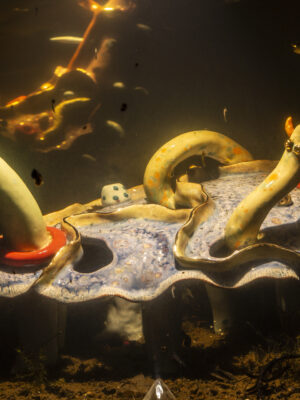
The gallery space is reconfigured as a subterranean passage rather than a site of display. In the exhibition, each element of tua mak’s dispersed body is named and presented using a stylised format, indicating imagined corporeal fragments that merge personal mythology, craft and more‑than‑human life in Song’s world‑building. This naming convention underscores the hybridity and multiplicity of tua mak as both ancestral figure and ecological presence throughout the installation. A monumental ‘microbeast’ sprawls across the floor, its tentacular extensions forming tunnels, compressions and obstructions that visitors must navigate bodily. These structures blur distinctions between organism, architecture and shrine, functioning simultaneously as shelter, digestive tract and ceremonial apparatus. Movement through the space is uneven and disorienting; there is no privileged viewpoint or central revelation. Instead, we become entangled within the exhibition’s circulatory system, subject to its rhythms and constraints.

Rae - Yen Song, 宋瑞渊 - •~TUA~• 大眼 •~MAK~• at Tramway, Glasgow, image credits Keith Hunter

At the core of this environment is a pond transported from the artist’s family garden in Edinburgh, not as a symbolic centre but as an active zone of transformation. Containing living microorganisms, the pond operates as a live instrument: sensors and submerged cameras translate microbial movement into multiple, discrete notes (recorded impacts of pond water in glass) that are played, controlled by, and heard around the pond itself in •~pond~• (tua mak’s qi).

•~pond~• (tua mak’s qi) in Rae - Yen Song, 宋瑞渊 - •~TUA~• 大眼 •~MAK~• at Tramway, Glasgow, image credits Keith Hunter

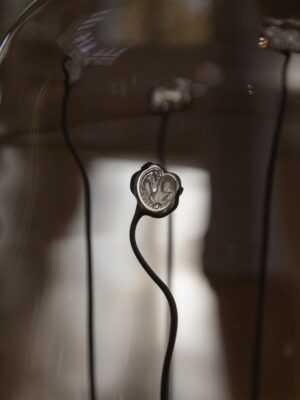
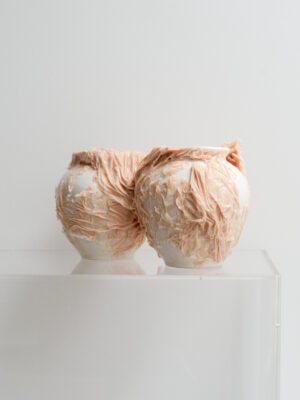
If tua mak is not presented as a figure to be recovered but as something grown, stitched, dyed, wired and kept alive, then what kinds of inheritance are being proposed through these acts of making? Across the installation, Song turns insistently to craft, not as a nostalgic gesture but as a way of fabricating lineage where continuity has been ruptured. In diasporic contexts, ancestry is often expected to be performed as coherent, narrated, preserved and made legible across time and (dis)placement. Song resists this demand. The sprawling •~microbeast~• (tua mak’s skin), with its fabric membranes, PVC sinews and internal LED glow, is not only an image of decomposition but a laboriously assembled body, one that holds together through touch, repetition and material negotiation. Similarly, the suspended •~clouds~• (tua mak’s breath), composed of hand dyed and inherited textiles, carry with them the residue of prior lives, reworked into forms that are activated through collective ritual rather than static display. Even the pond itself, •~pond~• (tua mak’s qi), is not simply relocated but carefully sustained, its microbial inhabitants translated into sound, light and image through a choreography of sensors, ceramics and code.


What does it mean to treat these processes, dyeing, stitching, assembling and sampling, as modes of ancestral relation, not as recovery but as ongoing construction? And what forms of knowledge persist here that evade documentation, that move instead through the body, through gesture, through the slow accumulation of skill shared across generations? By naming each element as a fragment of tua mak’s dispersed body (skin, breath, qi), Song does not stabilise the ancestor but multiplies its points of entry, refusing a single, knowable form. In this sense, the work edges toward a kind of opacity, as articulated by Édouard Glissant, where ancestry cannot be fully accessed, translated or resolved, but only encountered in partial and shifting states. Alongside this, a soundscape •~thunder~• (tua mak’s voice), developed with Flora Yin Wong, plays with the pond’s live sounds, distinct yet designed to coexist, informing the entire exhibition ecosystem. The inclusion of microbial and vegetal life within these systems of kinship does not simply expand the category of the ancestral, it unsettles the distinction between culture and nature altogether, proposing inheritance as a metabolic and more-than-human process unfolding across bodies, materials and time.

Rae - Yen Song, 宋瑞渊 - •~TUA~• 大眼 •~MAK~• at Tramway, Glasgow, image credits Keith Hunter

By assembling these elements into a continuously transforming environment, •~TUA~• 大眼 •~MAK~• dismantles familiar distinctions between life and death, human and non-human, nature and culture; not by opposing them, but by rendering such binaries structurally irrelevant. Culture emerges here as a metabolic process, shaped by consumption, decay and regeneration. The presence of living microorganisms ensures that the exhibition never settles into a fixed form; it shifts daily in response to ecological conditions. What is encountered is not an object to be observed, but a system to be entered, one that implicates the visitor as another transient component within its flows.

Song’s installation ultimately invites us to think from below: from the perspective of sediment rather than surface, circulation rather than origin. The underworld Song constructs is not a place of punishment or spectacle, but a zone of shared vulnerability and transformation. In this space, diasporic genealogy does not arise from mastery or visibility, but from proximity, contamination and the sometimes messy co-dependence that connects us with our environment and social structures. To engage with •~TUA~• 大眼 •~MAK~• is to accept ancestry not as something to be preserved intact, but as something that alters us – slowly, materially and irreversibly, as we pass through its subterranean networks of becoming.

Footnotes

1 Rae-Yen Song, •~TUA~• 大眼 •~MAK~•, exhibition Tramway, Glasgow, 2026.
2 Donna J. Haraway, Staying with the Trouble: Making Kin in the Chthulucene (Durham, NC: Duke University Press, 2016).
3 Gilles Deleuze and Félix Guattari, A Thousand Plateaus: Capitalism and Schizophrenia, trans. Brian Massumi (Minneapolis: University of Minnesota Press, 1987).
4 Lynn Margulis, Symbiotic Planet: A New Look at Evolution (New York: Basic Books, 1998).
5 A primordial figure of Chinese mythology and Daoism, according to legend, Pangu separated heaven and earth, and his body later became geographic features such as mountains and flowing water.
6 Norman J. Girardot, James Miller, and Liu Xiaogan, eds., Daoism and Ecology: Ways within a Cosmic Landscape (Cambridge, MA: Harvard University Center for the Study of World Religions, 2001).
Ricardo Reverón Blanco is a writer, curator, and mentor whose practice spans contemporary art, moving image, photography, and collective projects. He is the recipient of last year’s Michael O’Pray Prize, awarded for innovative and critical a pproaches to writing on moving image. His writing has appeared in Art Monthly , Film and Video Umbrella , Photomonitor , Photography+ , Photoworks Annual , and this is tomorrow , and he has contributed essays to numerous artist monographs and books.
@inner_effigies


Cover Image: Rae – Yen Song, 宋瑞渊 – •~TUA~• 大眼 •~MAK~• at Tramway, Glasgow, image credits Keith Hunter.


All images were provided by the author, and we publish them in good faith; responsibility for rights and permissions rests with the author.


This year we’re diving deep, with Underworld as the main theme. We invite our writers to find beauty and (re)generative power in the decaying, slimy and grotesque, in the things that have been relegated to the ‘underworld’ but which are immensely life-giving. We welcome a range of writing anchored in research and distinctive points of view, including short-format essays, articles and interviews.


Guest edited by isabel wang pontoppidan, Danish-Chinese writer, artistic researcher and jewellery maker based in Amsterdam. Her practice is multi-pronged, combining writing, performance, research and jewellery in a variety of overlapping cross-sections.


In 2026, you can look forward to a new series of 12 articles released on a monthly basis, this time on the topic of the Underworld. Our articles remain open to all readers for one month from the date of publication and thereafter become part of the CO archive available to subscribers only.