Betje Lazarus was born in Amsterdam on 27 March 1870. Together with her sister Sophie, she grew up in a city that had become an international centre of the diamond trade – an industry whose roots in Amsterdam stretch back to the sixteenth century, when goldsmiths, as well as diamond and ruby cutters, could already be found there. For many years, diamond manufacturing was regarded as precarious and poorly paid work, largely because the availability of precious stones fluctuated dramatically. Unaffiliated with any guild, the trade was dominated by Jewish workers, who, barred from joining most guilds, were left with limited professional opportunities.
The industry underwent a significant shift in the mid-nineteenth century, following the discovery of increasing numbers of diamonds in Brazil. Four years before the birth of Betje, in 1866, an enormous diamond was found in South Africa, with further notable discoveries soon after. As the employment in the cleaving, cutting and polishing of diamonds attained unprecedented heights, the sisters decided to try their luck as diamond workers. Although the profession was male-dominated, it was perceived as a suitable profession for women, and a variety of roles within the diamond industry were available to them.

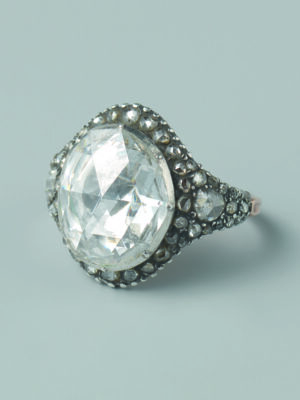
At the very top of the workers’ hierarchy were the diamond cleavers – the first to handle the rough diamonds – who had to master the greatest level of skill. Once the rough diamond had been divided into smaller, workable pieces, it was cut into shapes suitable for jewellery. Cutters were ranked according to the complexity of the forms they produced: the more intricate brilliant cut earned its makers higher wages, while the rose cutter, who worked on diamonds with flat bottoms, received far less. Most women in the industry, including Betje and her sister, found employment as the latter.
The sisters didn’t get to profit from the diamond boom for long. By the late 1890s, the industry found itself in a crisis. Trade slowed down, wages fell, and unemployment levels surged. Some of the smaller cutters and dealers attempted to enter the market, entering into competition with the established jewellers. Fiercer competition meant further depressed wages for the labour force, and the mounting tensions ultimately led to strikes. Although the market stabilised again after roughly five years, the craftsmen and women saw little benefit from the renewed prosperity.

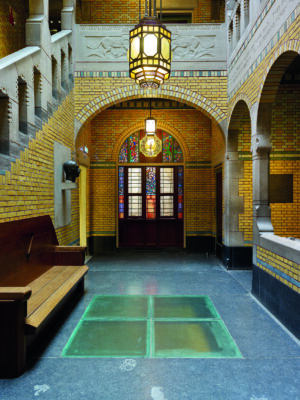
In late 1894, a major strike united a group of Amsterdam’s diamond workers. Their collective action against poor working conditions and unfair wages demonstrated the power of solidarity. Iconic figures such as Henri Polak and Jan van Zutphen rose to prominence after successfully negotiating higher wages with employers, and they soon helped establish a permanent union for diamond workers. On 18 November 1894, the General Dutch Diamond Workers’ Union (ANDB) was founded. The ANDB would serve as a federation of the preexisting diamond workers’ unions, each maintaining its own board and operating independently.
But who represented Betje Lazarus? As several attempts to unify rose cutters had failed, the craftswoman grew determined to become an active member of the union herself.
Following her notable appearance in the council chamber, she and her sister published a call to action in the union’s weekly magazine. Their simple plea – ‘We are the first; who will follow us?’ – received an encouraging response from colleagues. By 3 June 1896, the rose cutters had established their official union within the ANDB, with Betje Lazarus serving as its first president.

A little over a year later, Betje Lazarus made headlines again. Together with Sophie and another colleague, she travelled to Antwerp for the International Diamond Workers Congress. As the only female participants, they were received with enthusiasm. When the other labourers marched in procession to the conference venue, the three women were offered carriages instead. Yet Lazarus was not blinded by the special treatment; she remained focused on her goals and, during the congress meeting, pushed for equal pay for men and women.
Not long after, Betje Lazarus married and retired to start a family with her husband. After the birth of her daughter in 1903, the family struggled financially, likely due to her husband’s failing health. Betje was compelled to return to her former job as a rose cutter, later joined by her sister, who, like Betje, had originally left work upon marriage.
So how do we know about Betje? Like many women of her time, she had been largely omitted from history books. Fortunately, the archive of the ANDB has been preserved at the International Institute of Social History, where it was studied by Ulla Jansz, a historian who focuses on uncovering women’s contributions to history. With the recent digitisation of the archive, these records are now accessible to all. To explore the collection, head to https://diamantbewerkers.nl/en.