Tripaldi argues that surfaces are not imaginary boundaries but material regions where bodies construct complex networks of relations through interfaces both biological and technological. We might think of this in computational terms: the hardware on our desks and in our palms and the software that mediates between intention and action. These surfaces are sites of exchange rather than enclosure.
Growing awareness of the porosity of matter and environment reframes our fascination with interfaces and exposes unease with where things – and selves – begin and end.2 The surface is not, in fact, impenetrable; a membrane implies porosity. A body that leaks is transgressive because it lacks boundaries. ‘Why should our bodies end at the skin?’ wondered Donna Haraway, pushing us to think beyond, and through, the membrane.3
Under techno-capitalism, the body is a site of extraction and optimisation: surveilled, enhanced, deepfaked, filtered, and surgically altered. It becomes what we might call an ‘aesthetic operating system’: a site where identity, citizenship, and capital circulation are simultaneously performed and extracted. From health-tech companies and cosmetic and pharmaceutical industries to fashion brands, everyone wants a piece of you. Algorithmic assessment renders bodies perpetually inadequate, in need of the next upgrade. Body modifications have metamorphosed from a fringe or subcultural practice into a desire to sync one’s ‘flesh to a digital template that’s constantly evolving based on algorithmic feedback,’ argues Christina Adane.4
‘Why should our bodies end at the skin?’
~Donna Haraway
The luxury wellness industry exploits porosity under the guise of care. Smart jewellery like the Oura Ring or Samsung’s Galaxy Ring – biopower devices par excellence – succeed in training the body toward compliance precisely because they don’t look like technology. These sleek devices are embedded with sensors that monitor sleep stages, heart rate, body temperature, blood oxygen, and other activity. To consumers, they promise optimisation. The rings offer personalised scores and metrics, positioning biometric self-surveillance as a form of empowerment and even enlightenment about one’s own physicality. Their ‘screenlessness’ is no less extractive. By eliminating the friction that might alert users to constant monitoring, these devices naturalise surveillance into an ambient state.6
This ecosystem transforms not just how bodies are measured, but what bodies are, rendering them permeable to corporate extraction while making access to one’s own biological information conditional on payment. Biometric wearable technologies don’t merely measure a pre-existing body; they produce the very boundaries between ‘body’ and ‘device’, ‘user’ and ‘data’, making literal the fantasy that information can exist independently of its material substrate and creating a two-tier bodily citizenship where the ‘body politic’ – that old metaphor for collective political life – now describes a literal condition: bodies made politically legible only through their porosity to extraction. Those who can’t or won’t pay lose access to their own biological intelligence. Here, the political is reframed as strictly personal: you can pay for access to your own biometric data, or you can opt out entirely. It’s totally up to you!
As the lifecycles of both technologies and trends accelerate, we grow nostalgic for the gadgets of our youth: iPods, MP3 players, wired earbuds, digital cameras. Portable devices that can easily double as accessories. Brands have already begun to tap into this longing, reimagining the past for a present hungry for tactile, sentimental encounters, recasting tech objects as speculative adornments that resist the demands of communicative capitalism.
Estonian brand Racer Worldwide, known for its aughts youth culture-inspired design, recently came out with the RacerPod Pendant, a metallic jewellery piece crafted in the exact form of a real-size MP3 player, which can be styled as a clip on the clothes or in combination with their RacerPods Necklace, a necklace shaped like the original Apple wired earphones. On the brand’s website, the copy states that the RacerPods ‘are deliberately, gloriously useless’. In stripping away the original’s functionality, they reimagine electronics as pure adornment, nodding to digital culture while refusing its extractive logic. This is jewellery that doesn’t want anything from you.
‘The horror isn’t actually permeability itself; it’s the loss of agency over what crosses the membrane, and in whose interest.’
~Eleni Maragkou
While the aestheticisation of functionally useless adornment can ring hollow, it also reveals a deeper yearning for expressions that slip past optimisation altogether. For these material interventions to meaningfully counter the disembodied logic of techno-capitalism, they have to reach deeper, past the surface layer of skin and into the zones where embodiment is actually negotiated. This fusion of flesh and machinery, a staple of body horror, refracts anxieties about media, surveillance, and the body, casting media as a site of profound psychic and bodily violation.7 Technology penetrating flesh is monstrous; the body should therefore be re-sealed. But bodies are always already permeable. The horror isn’t actually permeability itself; it’s the loss of agency over what crosses the membrane, and in whose interest.
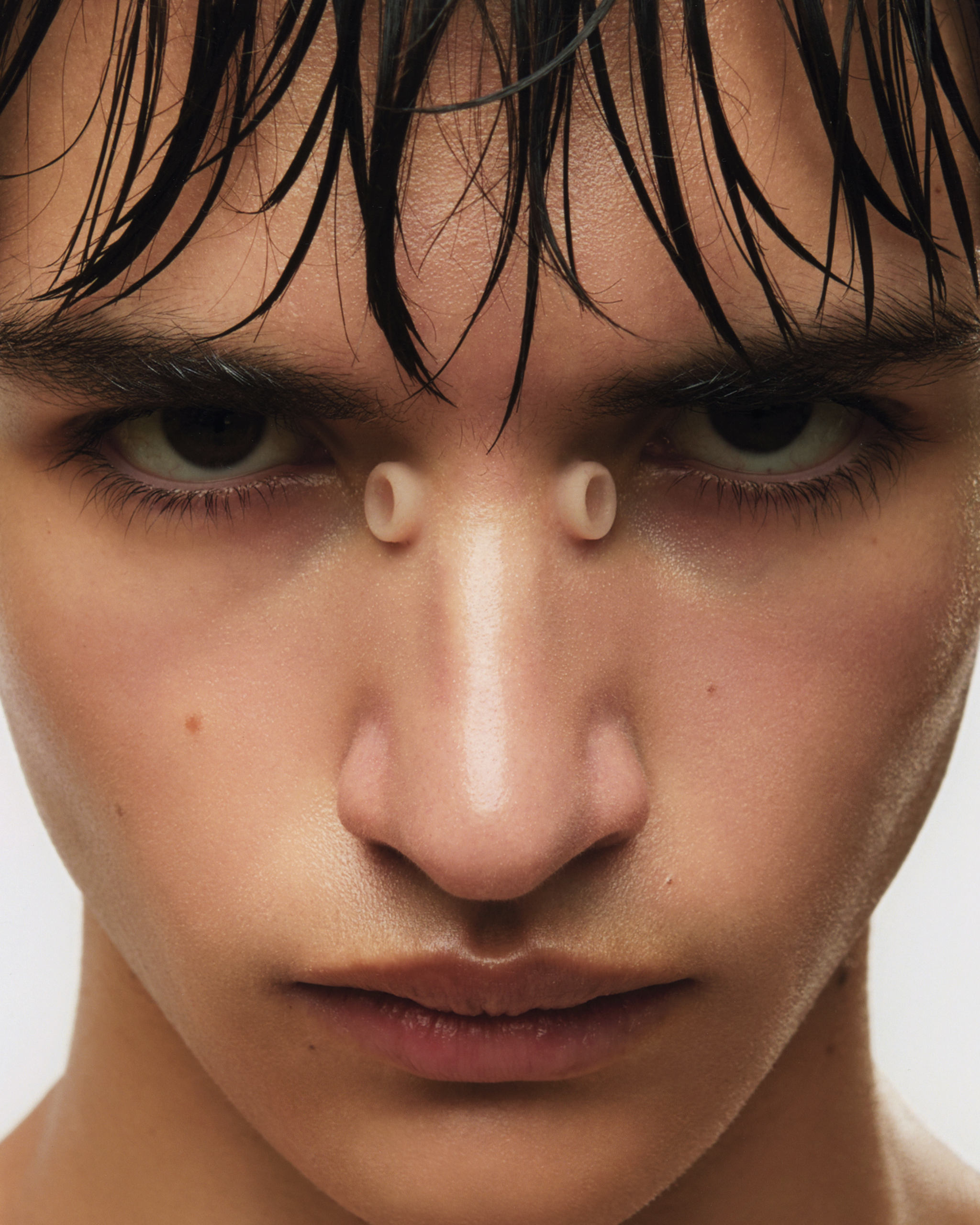
From devices that sit on the skin to implants that penetrate it, latching onto the epidermis and burrowing deep beneath the surface, speculative wearables can turn this nightmare scenario into a site for experimentation. Rethinking the skin as a boundary is to imagine the body as a continuum of experiences – mutable, responsive, and entangled with the world. We can already find these seeds in design. For his latest collection, Stonehaven, Paris-based designer Rohan Mirza created second skins for the algorithmic age: headphones, watches, ammunition embossed directly onto skin as raised, almost tumourous prosthetics – technology that isn’t worn but rather absorbed.
Patio Studio’s SNAP IMPLANTS push this further into the realm of provocation. The speculative project imagines subdermal implants as physical input/output ports embedded in the skin, transforming nerve endings into literal connection points. A collection of accompanying objects further reinterprets the connection between body and everyday items, blurring the boundaries between utility and ornamentation. If Mirza aestheticises technological absorption, SNAP IMPLANTS literalises it: the body is not monitored by devices but becomes compatible with them, a peripheral awaiting connection.
Beyond curated galleries and the runway, Pinterest is the vernacular moodboard: a network of drifting, authorless imagery, always hinting toward (sub)cultural undercurrents. When paying attention to these shared visual experiments, we can see how desires for relational futures are already circulating. What are we collectively rehearsing when we pin soft prosthetics, fantastical implants, and useless wearables? As the body slides into malleable materiality, it becomes wetware.
In its original sense, wetware refers to an organism’s generative code: its genes, cellular biochemistry, and tissue architecture. Wetware names what hardware and software exclude: the messy, organic materiality of computation. Where hardware implies rigidity and software suggests abstraction, wetware insists on what Mindy Seu calls ‘the embodied, slimy components of technology, and the organic, rhizomatic nature of networks’.8
By embedding tech objects into the body, we can upend the fantasy that digital technologies must be cold and unfeeling – and insist that they become tender, not that we harden. This can’t be done uncritically. Visibility and vulnerability are so unevenly distributed; some (white, thin, cis, able-bodied) get to experiment at the edges, while others are disciplined more harshly by the same technologies that promise empowerment.
If software ate the world and AI is eating software9, could wetware forge a different path? I am not suggesting that we place our hopes entirely upon conceptual, aesthetic, or ornamental interventions. Yet such examples can show us the path we’re on, by revealing how deeply we’ve internalised techno-capitalism’s logics. When positioned aspirationally rather than critically, tech-as-flesh smooths the interface between flesh and capital rather than jamming it. It’s possible that, by remaining trapped in individualised body modification, we risk aestheticising compatibility with the very systems of extraction we might seek to critique.
To embrace the more slimy and rhizomatic qualities of technology, we ought to treat speculative wearables and implants less as prototypes for the next product cycle and more as provocations, asking: What if porosity flowed in multiple directions – not just outward to corporations but horizontally between bodies, creating networks of mutual aid rather than extraction? Can we imagine interfaces that attend to the body’s need to be unproductive? These aren’t questions with immediate technical solutions. They require reimagining the entire infrastructure of the relation between bodies and technologies – moving from individual upgrades to collective care and making machines finally compatible with the messy, leaky reality of embodiment.
Footnotes
Title After the last line in Videodrome, 1983, dir. David Cronenberg: “Long live the new flesh.”
1 Laura Tripaldi, Colloidal Ontologies: The Gendered Body at the Interface of Matter (PostScriptUM 2023).
2 Christina Monahan, ‘+Accessorising Networked Bodies+’ Burn After Reading (2025) https://morningfyi.substack.com/p/accessorising-networked-bodies
3 Donna Haraway, ‘A Cyborg Manifesto: Science, Technology, and Socialist-Feminism in the Late Twentieth Century’ in Simians, Cyborgs and Women: The Reinvention of Nature (Routledge 1991) 149–181.
4 Christina Adane, ‘BBL Baddies and the Birth of Soft Transhumanism’ Consuming (2025) https://consuming.substack.com/p/bbl-baddies-are-an-early-form-of
5 PJ Flanagan, D Papadopoulos, and G Voss, ‘Intimacy and Extimacy: Ethics, Power, and Potential of Wearable Technologies’ in W Barfield (ed), Fundamentals of Wearable Computers and Augmented Reality (2015).
6 BC Coldron and others, ‘Giving Surveillance Capitalism a Makeover: Wearable Technology in the Fashion Industry and the Challenges for Privacy and Data Protection Law’ in E Rosati and I Calboli (eds), The Oxford Handbook of Fashion Law (Oxford University Press 2025).
7 To account for the various – biometric and otherwise – horrors our bodies are subjected to in the algorithmic age, artist Zach Blas has coined the term “computational body horror”: violence through abstraction, quantification, and control. See: K Ancāns and CL Apostol, ‘Towards Computational Body Horror: In Conversation with Zach Blas’ in L Nolasco-Rózsás and M Schädler (eds), Beyond Matter, Within Space: Curatorial and Art Mediation Techniques on the Verge of Virtual Reality (ZKM Karlsruhe 2023).
8 ‘VNS Matrix, ‘WETWARE’ (2022) https://vnsmatrix.net/events/wetware
9 In 2011, venture capitalist Marc Andreessen declared that “software is eating the world”. See: Marc Andreessen, ‘Why Software Is Eating the World’ Wall Street Journal (20 August 2011) https://a16z.com/why-software-is-eating-the-world/ accessed
Eleni Maragkouis is a writer, editor, researcher, and cultural worker based in Amsterdam, NL. She thinks a little bit too much about the infraordinary and extraordinary effects of digital technologies on our lives.
Cover Image: Carlos Ojeda Jiménez • Patio Studio • SNAP IMPLANTS • 2025
All images were provided by the author and obtained from open sources. We publish them in good faith; responsibility for rights and permissions rests with the author.
This year we’re diving deep, with Underworld as the main theme. We invite our writers to find beauty and (re)generative power in the decaying, slimy and grotesque, in the things that have been relegated to the ‘underworld’ but which are immensely life-giving. We welcome a range of writing anchored in research and distinctive points of view, including short-format essays, articles and interviews.
PERMEABLE BODY explores bodies (human or otherwise) as porous entities, with the ability to chemically and physically change in relation to their environment. Focusing on how information crosses spaces and membranes to transfer from one body to another, from outside to inside or vice versa, the permeable body is ultimately relational.
Guest edited by isabel wang pontoppidan, Danish-Chinese writer, artistic researcher and jewellery maker based in Amsterdam. Her practice is multi-pronged, combining writing, performance, research and jewellery in a variety of overlapping cross-sections.
In 2026, you can look forward to a new series of 12 articles released on a monthly basis, this time on the topic of the Underworld. Our articles remain open to all readers for one month from the date of publication and thereafter become part of the CO archive available to subscribers only.