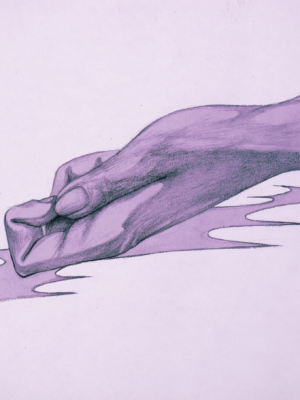
I, a non-believer, suddenly felt my beliefs become permeable and promiscuous, grief expanding the realm of what is possible to all of what I practised despite not believing in it. I felt a faith Johanna Hedva, a writer and witch devoted to ‘deviant forms of knowledge’1, referred to as ‘shapeshifting and malleable’2. Small rituals my muscle memory routinely performed now gained a new significance: changing sitting positions if something sinister is mentioned, not wishing someone a happy birthday before the day itself, avoiding opening two windows simultaneously so as not to cause a draft, or holding a button on your shirt if an ambulance passes.
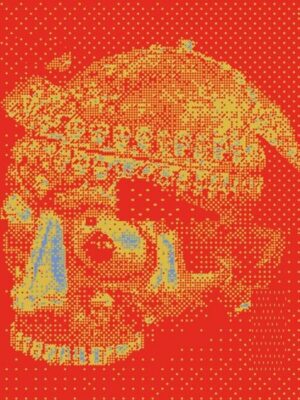
These and many other mere ‘superstitions’ are embedded in the fabric of my land of origin – Serbia. They are colloquially said to be done ‘protiv uroka’, or so as to avoid casting an evil spell unbeknownst to you or inviting bad faith3. What many don’t realise is that this behaviour is part of a larger phenomenon: these ritual practices are predominantly derived from pagan times, ‘creating those whimsical combinations of paganism and Christianity labelled in Church Slavonic vocabulary as “double faith” (dvoeverie)’4. Double faith has made it possible for pagan traditions to sneakily persist through the Christianisation of the Slavs and weave themselves into the norms of Orthodox Christianity5. Together, they compose a dizzying soil for navigating grief, whether individual or collective.
‘The permeable system of belief allows for an expansion of possibility. Here, an onion in your pocket and a prayer carry a similar weight.’
The former Yugoslav region is in many ways drenched in grief: both unacknowledged post-war grief and grief for a future that never came. What was once a promise of economic and political stability, synonymous with joining the ‘Western world’, turned into a brain drain of youth in search of a better future and life-threatening corruption6.
This prolonged grief and its lingering haunting led (and still leads) to a perpetual growth: Christianity, tarot readings, foretelling the future and old cures for modern ailments all spread indiscriminately7. The permeable system of belief allows for an expansion of possibility. Here, an onion in your pocket and a prayer carry a similar weight, which is all the more important when one remembers that Orthodox Christianity is primarily a liturgical faith, meaning that it relies on ritual instead of the written word to spread its teachings8. So whether superstitious or religious rituals are concerned, they both send signals through our bodies and spread encoded meanings and whole histories whenever they’re performed. They communicate through us even when we claim not to believe in their transmission but perform them just in case. In some sense, the meaning of these superstitions and rituals sneaks past us and the dominant forces which were ‘supposed to’ prevent them from spreading.
I often ask myself how this history of clashing but co-existing beliefs impacts our meaning-making. Not just on an individual level, but on a cultural one.
Double faith here pops up like a noisy belief earworm, which lingers, takes up space in our memory and embeds itself into our mundane habits. By doing so, it spreads its area of association to many of the situations we go through individually and societally, thereby permeating the fabric we call culture.
Juxtaposition in noise
Belief, much like a tune, can sneak beneath the semantic register of a dogmatic religion and weave itself into our lives. You catch yourself singing the words to a song you weren’t aware of knowing. Double faith imprints meaning through the repetition of gestures, words, but also melodies. This is arguably its most enticing characteristic; something you never paid attention to wedges itself into your unintentional memory. This seems to be a largely involuntary process with music: sound travels through your body when it’s performed; even when you disengage, it has the potential to embed its noise within your subconscious. When I consider art that embodies this tenet of double faith, a genre-bending band springs to mind: ‘azza & kapale’9.
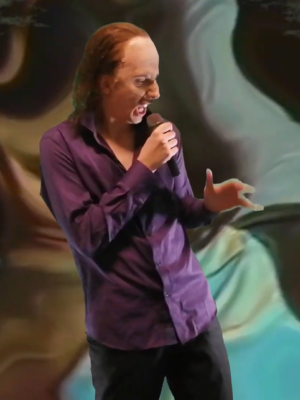
This musical project is part of the hauntological scene of the post-Yugo region, known for mashing together old folk songs, turbo-folk renditions, samples of presidential speeches and sound bites from familiar cartoons and video games. Slobodan Vujanović, a pop culture critic with a focus on music and film, characterised their work as being a ‘hyper-consumer, [one] who doesn’t have a responsibility to be devoted to or respect any genre’10. While they do layer sound without a dogmatic approach to continuing a musical legacy, this doesn’t make them faithless. Instead, through a performed ‘lack of belief’ in the clashing noise, they evoke a past most try to forget – that of a decade-long civil war accompanied by its own soundtrack – turbo-folk11. This musical genre has been notoriously despised by anyone politically opposed to the Serbian aggression of the 90s. Jennifer C. Lena, a cultural sociologist concerned with genre classification, has written about turbo-folk (specifically in its original form) as ‘state-sponsored, government-purposed music’, but colloquially it is often perceived as blue-collar, unintellectual and simply uncultured12. Some people even refuse to listen to it as if to avoid a ‘bad omen’ or a subconscious effect on one’s mind and morals. As a result, these same people neglect a past that they too were a part of, whether in subtle or overt ways. But azza & kapale acknowledge the complexity of this cultural history through juxtaposition, clash and overlap. Turbo-folk here isn’t merely given a platform, but it is changed and queered.
‘Double faith imprints meaning through the repetition of gestures, words, and melodies. This is arguably its most enticing characteristic; something you never paid attention to wedges itself into your unintentional memory.’
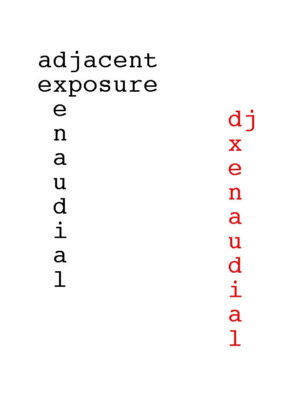
A similar phenomenon can be heard in xenaudial’s album ‘Adjacent Exposure’, in which two clashing songs are combined into one to form ‘double earworm inductions’13. What at first sounds like a crime against rhythm is now inseparable; once you hear one of the songs alone, you miss the presence of the other. They’re tied in your memory for better or for worse.
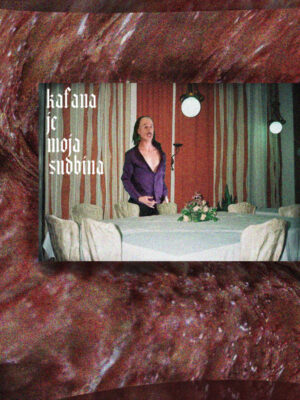
Although azza & kapale don’t credit the sounds they use and have more rhythmical compositions than xenaudial, they achieve a similar binding effect by adjusting a cultural memory. They sneak beneath the semantic register through a juxtaposition in noise. A bit tongue-in-cheek, azza & kapale combine eclectic songs such as Hanka Paldum’s ‘Prolazi moja mladost’, the folk song ‘Gusta mi Magla’ and Grand Master Flash’s ‘White Lines’ into a jarring soundscape. As Vujanović noted of a previous album, only a few years back this trespassing would have been like ‘crossing a barbed wire fence’ or constituted ‘sacrilege’14. The implication is that you cannot mix a genre born out of nationalism and ethnic hatred (turbo-folk) with indie because their politics simply don’t match. Yet, this musical approach acknowledges the fact they co-existed for many years. It encompasses the contradictions of a past many try to bury – that of violence against former Yugoslav neighbouring countries that was committed in ‘their name’ (their here being the Serbian people). It works with the haunting.
‘A song becomes yet another ritual which encodes what you remember. Once sound is performed, it reverberates through your body, furthering a past into a future.’
In Orthodox Christianity, the dominant religion in Serbia, ‘ritual relies on the body as a vessel to transmit and teach, to tell the message embedded within it’15. And the permeability of belief in this region creates an opening for rituals we just performed to be reified in our lives and the collective imaginary. Unbeknownst to us, regardless of what we actually claim to believe, we remember through performing a ritual16. Through repetition, things without a causal connection can gain one in our memory. Many neglect the power of transmission, overlooking the possibility that this is how we construct a version of the future. So, they might disengage from music that is in proximity to a time ‘best forgotten’, without understanding how this forgetting might change them and their collective trajectory. With a history of religious rituals that relied on the spoken, sung, performed and embodied to remember, a song becomes yet another ritual which encodes what you remember. Once sound is performed, it reverberates through your body, furthering a past into a future.

Formally, since 2016, recognised ritual practices such as fortune-telling, dream analysis and sorcery have been outlawed in Serbia17. What was formerly hiding in plain sight (double faith) is forced to disappear once more and find a new way of sneaking beneath the register of an established system of belief.
The permeable belief of this land leaves space for making meaning through magical means. For this, we don’t need rituals which perpetuate a sanitised version of the past, but instead ones whose clash and noise embed messages with most of the ghosts still intact (in the reverb or the drone). Melodies which won’t leave our bodies once they’re played, no matter – or precisely because of – how incongruent they sound. In this way, future generations decoding the sounds of a familiar tune whose origin was long forgotten will be able to uncover what dominant forces tried to sweep under the rug.
Footnotes
1 J. Hedva, ‘about’, Johanna Hedva, https://johannahedva.com/about.html, [accessed 30 May 2026].
2 J. Hedva, ‘How to Tell When You’re Going to Die: Astrology for Writers,’ Wxtch Craft, Royal Academy of Art, the Hague, 2020.
3 The meaning of the word ‘urok’ here is in the context of BCSM (Bosnian, Croatian, Serbian and Montenegrin-speaking) and means ‘a view or action that could attract evil, misfortune, sickness’ (Jezikoslovac.com, ‘urok’, Jezikoslovac.com rječnik,
https://jezikoslovac.com/word/yff5[accessed 27 April 2026]). It is a false friend in other Slavic languages, often meaning charm, appeal, beauty, but also spell.
4 R. Jakobson, ‘Slavic Gods and Demons’, in Roman Jakobson Selected Writings, 7th edn. Berlin, New York, Amsterdam, Germany: Mouton Publishers, 1985, pp. 3–4.
5 The Christianization of Slavic tribes happened roughly from the 7th to the 12th century.
6 At the time of writing this essay, many fatal incidents of corruption have been rightfully addressed in the news: 16 dead from the collapse of the Novi Sad train canopy (Serbia) and 59 dead from the fire in a nightclub in Kočani (Macedonia).
7 This was also prominently featured in pop culture, in shows featuring ‘fortune-tellers’ Kleopatra and Milan Tarot, who would answer questions about the future from worried viewers. To get a better insight into this, read ‘Superstitious Serbia’ by Mona Mangat.
8 Due to the length of this essay, this is not explained in detail, but I’ve written more extensively of how it relies on body memory and remembrance in the referenced essay ‘A Momentary Lapse in Memory: An Inquiry into (Re)Memory and Trauma Embodiment’.
9 azza & kapale, azza & kapale, bandcamp, 2021.
10 S. Vujanović, ‘FRIDUME, NE BUDI PIČKA: AZZA & KAPALE – Azza & Kapale (Samizdat 2021)’, MISLITE MOJOM GLAVOM, 2021.
11 M. Đorđević-Kisačanin, ‘Orientalizing Turbofolk: Balkan Hybrid Identity and Responses to Ottoman Heritage’, SCALAR, 2019.
12 J. C. Lena, Banding Together: How Communities Create Genres in Popular Music, Princeton University Press, 2012.
13 xenaudial, Adjacent Exposure, bandcamp, 2013.
14 S. Vujanović and O. Lopušina, ‘FRIDUME, NE BUDI PIČKA: AZZA – Kafana je moja sudbina (Bandcamp 2019)’, MISLITE MOJOM GLAVOM, 2020.
15 S. Milutinović, ‘A Momentary Lapse in Memory: An Inquiry into (Re)Memory and Trauma Embodiment’, Amsterdam Museum Journal, 2023, War, Conflict and the City, no. 1 (Fall 2023), pp. 80–97.
16 To read more about this, consult Paul Connerton’s work on bodily social memory in How Societies Remember. Cambridge: Cambridge University Press, pp. 4–5, pp. 70–71.
17 Zakon o javnom redu i miru, Službeni glasnik RS, no. 6/2016 and 24/2018, vol. IV-6: Pravosuđe, sudski i drugi postupci i kazneno zakonodavstvo (Kazneno pravo), 2018.
Reference List
azza & kapale, azza & kapale [album], Bandcamp, 2021,
https://azzaikapale.bandcamp.com/album/azza-kapale
[accessed 1 April 2026].
Connerton, P., How Societies Remember (Cambridge: Cambridge University Press, 1989), pp. 4–5, 70–71.
Dawkins, R., The Selfish Gene (Oxford: Oxford University Press, 1976), pp. 203–204.
Đorđević-Kisačanin, M., ‘Orientalizing Turbofolk: Balkan Hybrid Identity and Responses to Ottoman Heritage’, SCALAR, 2019, OLD BEATS, NEW VERSES: 21 NEWLY COMPOSED ESSAYS ON TURBO-FOLK,
https://scalar.usc.edu/works/turbofolk/orientalism-in-turbofolk
[accessed 1 April 2026].
Eurovicious, ‘Turbofolk: how Serbia’s weird and wonderful pop music came in from the cold’, New East Digital Archive, 2017,
https://www.new-east-archive.org/articles/show/7805/turbofolk-serbias-weird-wonderful-pop-music
[accessed 1 April 2026].
Górska, E., ‘Memory Activism: Methods of Creating Alternative Memory in Israel and Yugoslavia’, Maska, 32 (2016), pp. 8–20.
Hedva, J., ‘about’, Johanna Hedva,
https://johannahedva.com/about.html
[accessed 30 May 2026].
Hedva, J., ‘How to Tell When You’re Going to Die: Astrology for Writers’, Wxtch Craft (Royal Academy of Art the Hague, 2020),
https://www.kabk.nl/en/events/online-studium-generale-lecture-johanna-hedva
[accessed 1 April 2026].
Jakobson, R., ‘Slavic Gods and Demons’, in Roman Jakobson: Selected Writings, 7th edn (Berlin: Mouton Publishers, 1985), pp. 3–4.
Jezikoslovac.com, ‘urok’, Jezikoslovac.com rječnik,
https://jezikoslovac.com/word/yff5
[accessed 27 April 2026].
Lena, J. C., Banding Together: How Communities Create Genres in Popular Music (Princeton, NJ: Princeton University Press, 2012).
Mangat, M., ‘Superstitious Serbia’, Balkan Insight, 2010,
https://balkaninsight.com/2010/05/10/superstitious-serbia/bi/all-balkan-countries/
[accessed 1 April 2026].
Milutinović, S., ‘A Momentary Lapse in Memory: An Inquiry into (Re)Memory and Trauma Embodiment’, Amsterdam Museum Journal, 2023, War, Conflict and the City, no. 1 (Fall 2023), pp. 80–97,
doi:10.61299/7j_g101.
Vujanović, S., ‘FRIDUME, NE BUDI PIČKA: AZZA & KAPALE – Azza & Kapale (Samizdat 2021)’, MISLITE MOJOM GLAVOM, 2021,
https://mislitemojomnovomglavom.wordpress.com/2021/11/05/fridume-ne-budi-picka-azza-kapale-azza-kapale-samizdat-2021/
[accessed 1 April 2026].
Vujanović, S. and O. Lopušina, ‘FRIDUME, NE BUDI PIČKA: AZZA – Kafana je moja sudbina (Bandcamp 2019)’, MISLITE MOJOM GLAVOM, 2020,
https://mislitemojomglavom.blogspot.com/search?q=azza
[accessed 1 April 2026].
xenaudial, Adjacent Exposure [album], Bandcamp, 2013,
https://xenaudial.bandcamp.com/album/adjacent-exposure
[accessed 1 April 2026].
Zakon o javnom redu i miru, Službeni glasnik RS, no. 6/2016 and 24/2018, vol. IV-6: Pravosuđe, sudski i drugi postupci i kazneno zakonodavstvo (Kazneno pravo), 2018.
Cover Image: S. Milutinović, Just in Case, 2026
All images were provided by the author, and we publish them in good faith; responsibility for rights and permissions rests with the author.
This year we’re diving deep, with Underworld as the main theme. We invite our writers to find beauty and (re)generative power in the decaying, slimy and grotesque, in the things that have been relegated to the ‘underworld’ but which are immensely life-giving. We welcome a range of writing anchored in research and distinctive points of view, including short-format essays, articles and interviews.
Guest edited by isabel wang pontoppidan, Danish-Chinese writer, artistic researcher and jewellery maker based in Amsterdam. Her practice is multi-pronged, combining writing, performance, research and jewellery in a variety of overlapping cross-sections.
In 2026, you can look forward to a new series of 12 articles released on a monthly basis, this time on the topic of the Underworld. Our articles remain open to all readers for one month from the date of publication and thereafter become part of the CO archive available to subscribers only.