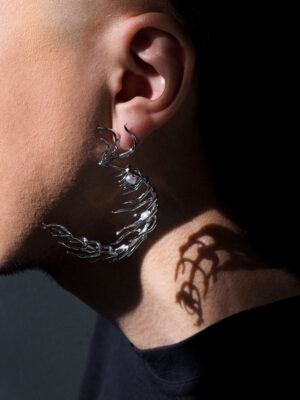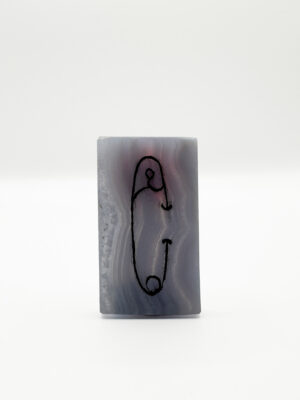
German-born and Netherlands-based, Clara Schweers established her practice on the threshold of glass-making and virtual storytelling, translating digital movements into tangible glass forms. Taught to digitise all prototypes during her studies, she became proficient in 3D modelling long before she picked up glass. Her initial experiments with the physical craft were small in scale: Working on such a scale taught me patience and precision. I think many of my larger works today actually originated through my intimate jewellery-scale pieces rather than through digital modelling.
At the time, the two practices remained largely separate. I guess over time the 3D realm became a comfort tool that I could use from anywhere, and glass became a curiosity to practice with lots of room to fail and start over.
Eventually, the two merged – with ‘A bit of love’ being among the recent products of that intermedial relationship.
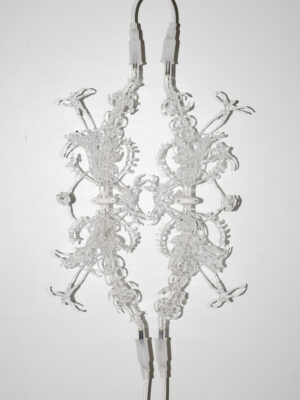
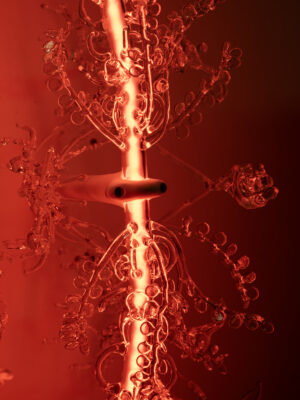
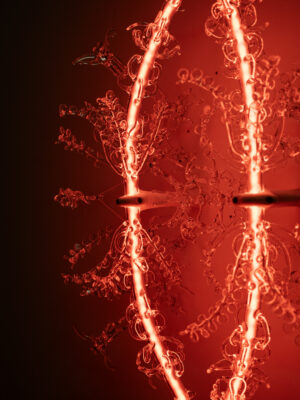
Glass wasn’t a deliberate answer to her digital process – it entered ‘almost independently’, as Schweers puts it. But it ended up fitting her practice flawlessly. Sitting at the literal boundary between the physical world and virtual reality – embedded in the screens and monitors we use – glass mediates both connection and separation between the tangible and the digital: It is the material we most often look through when we enter digital spaces – phone screens, computer monitors and tablets. In that sense, the digital realm is already experienced through glass.
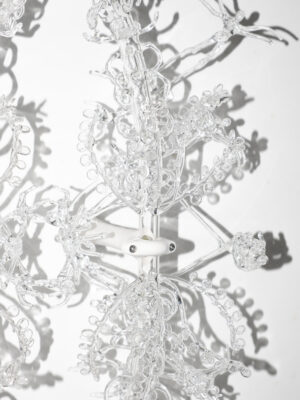
‘ It has become a material of meditation for me. It is the material we most often look through when we enter digital spaces – phone screens, computer monitors, and tablets. In that sense, the digital realm is already experienced through glass.’
The sharp contrast between 3D modelling and physical craft plays into the development of Schweers’s practice, but is not an obvious statement. Instead, her pieces are a result of an intricate dance between the two techniques. I wouldn’t say that my work is an attempt to replace digital experiences with physical ones. My experience of the digital is primarily a visual one. I absorb those visual narratives, gestures and movements, internalise them, and then perform or reinterpret them back into the physical world. That’s where my work begins.
‘My experience of the digital is primarily a visual one. I absorb those visual narratives, gestures and movements, internalise them, and then perform or reinterpret them back into the physical world. That’s where my work begins.’
She cites working with .fbx motion files in Blender as a starting point. Over time, struck by how many animated motions revolve around violence or spectacle, she began questioning the near absence of movement reflecting quieter moments in life – ‘when we kiss, cry or feel lonely’.
In response to the observations, Schweers began manipulating the motion files by pulling them away from their intended use and searching for gestures that encapsulate those quieter moments of human existence. These files contain pre-recorded human movements, and by distorting the underlying rigs – almost pulling the digital skin away from the skeleton – I discover forms that I later reinterpret in glass. … For example, a simple ‘sleeping-in-place.fbx’ animation became a scene where two figurines lie together, with one hugging the other from behind. By copying the figurine and slightly altering the movement, I could create a completely different emotional meaning from the original animation.
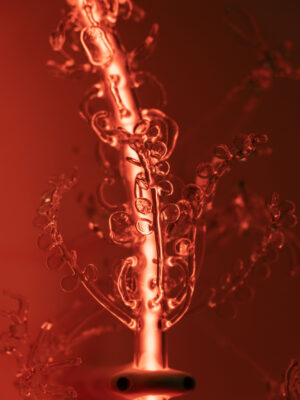
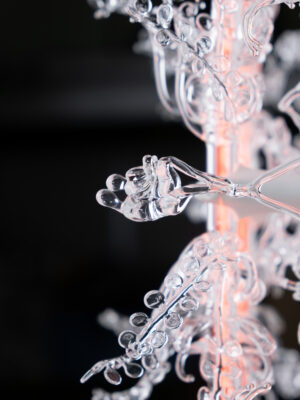
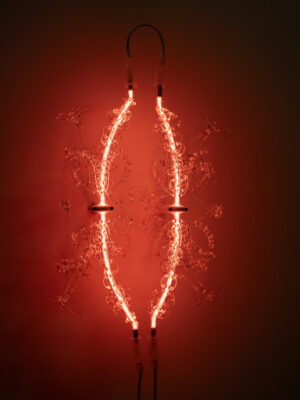
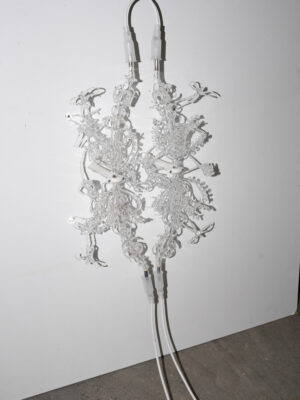
Once she locates an emotionally resonant gesture, the process enters the physical stage. The forms are then reinterpreted into tangible sculptures: These distorted digital movements are reimagined through techniques such as glass fusing and flameworking, resulting in fragile yet precise mirrors, neon works, animations and installations. In ‘A bit of love’, the statuettes are not standalone, but instead create a sequence, akin to a stop-motion animation – created frame by frame, arranged in a chain of interactions. Their gestures intensify as the chain progresses, leading up to four figures caught at the cusp of a kiss. They exist in that moment before something happens, between stillness and movement, Schweers says. As a result, the work becomes a ‘solid sequence that is almost about to move, but never fully does’.
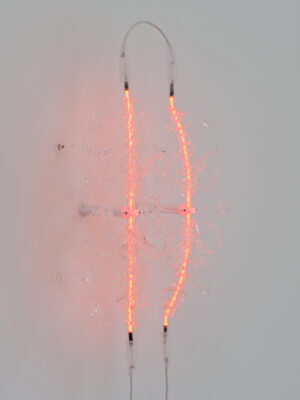
For her next series, Schweers aims to deepen her research and exploration within the motion files’ libraries. This time, she will focus on the feeling most of us can relate to – being split between the physical and virtual reality: The work is about feeling partly present, partly online and partly entangled in the images, narratives and behaviours we absorb through screens. A central question for me is the relationship between intimacy and display. Glass has always been connected to ways of viewing – it is a material we look through, a material that gives access to another space. I am interested in how we extract gestures, emotions, ideals and ways of relating from the images we consume, and how these experiences become part of ourselves. Right now I am trying to visualise exactly that transition.
Artist: Clara Schweers, @claerira
All featured images are courtesy of the artist.
Do you have a new collection or body of work that is simply dazzling? We want to hear from you! And remember, there is no deadline – we welcome submissions throughout the whole year!
Every submission is a potential gem, and our team takes great care in handpicking projects that resonate with the contemporary scene.
To submit your work, just fill in [this form], including high-resolution images (5–10 pcs in JPEG or PNG format), image credits, social media tags, work description (max 500 words), and artist bio (max 250 words).