The legacy of jewellery in the Western world is rooted in the long-held, classical relationship between morality and aesthetics. Originally modelled on Plato’s writings on the associations between beauty and divinity, this paradigm dictates that beauty is a moral virtue and, conversely, ugliness is a moral failing¹. This relationship was then echoed in Kant’s Critique of the Power of Judgment, which proposed that beauty is a symbol for that which is morally good². In the contemporary context, this relationship between virtue and aesthetics is not politically neutral, as these values are loaded with colonial and classist implications that reinforce systems of power and exclusion. Within these standards, aesthetics are weaponised to marginalise bodies, cultures and forms of expression which are perceived as ‘other’ or abject. Adornment has a unique role in this framework, as it has long operated as a signifier of wealth and status. The precious metals, stones and other materials used in jewellery therefore hold not only financial value but also promises of virtue and self-optimisation.
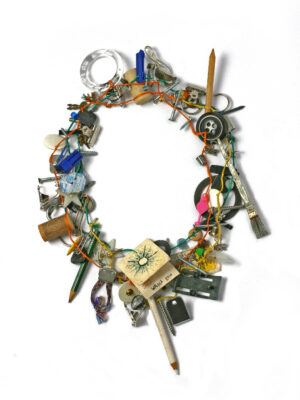
Walker’s work makes no such promises, instead positioning itself as a disrupter and an irritant which threatens to undermine, rather than enforce, taste. With Walker’s unconventional materiality, particularly her use of the ready-made, each piece interrupts these classification systems and destabilises the conventions of adornment. This is articulated in her work What Karl didn’t take with him (2010), where the masses of debris and junk which had been collecting on the surfaces of her home or falling discarded onto the floor are bound and glued together with bright cotton thread. Pencil stubs, paper clips, an empty soy sauce bottle and other discarded items jostle against each other in a work which is more reminiscent of a home junk drawer than traditional goldsmithing.

Positioning these waste materials in dialogue with one another and situating them within the context of adornment fractures any semblance of their original functionality. Stripped of utility, these common forms are instead suspended in a state of contradiction and liminality. In this new world, aesthetic boundaries blur and each of the pieces is decontextualised until they become familiar whispers without fixed time or place.
By crafting a methodology free from definitions and temporal grounding, Walker is able to create pieces which refuse completion. This rejection challenges the traditional aesthetic judgements of fine art, where ‘wholeness’ is valorised as an indication of skill and taste. Within this canon, presenting works which relish in their own fragmentary and incomplete identity is transgressive. Instead of seeking finality and stability, Walker’s works articulate an intuitive process of becoming and unbecoming. For Walker, these states exist in harmony, not opposition, as her practice suspends objects in states of regeneration – suggesting liberation can be found within liminality.
‘Stripped of utility, these common forms are instead suspended in a state of contradiction and liminality.’
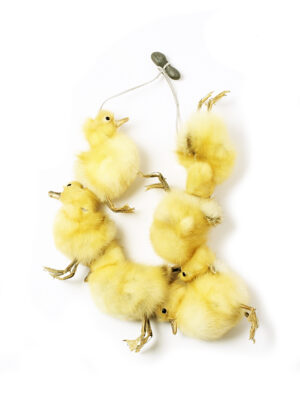
This is also articulated in her 2016 piece Necklace, now held in the Te Papa collection. Akin to the liminality of What Karl didn’t take with him, Walker’s string of taxidermy ducklings, suspended by thread and steel compound, creates a space of transmutation. The discarded remains of the bio-industry are sublimated into objects of desire, elevating offal to the status of precious stones. Walker uses this unsettling representation of death to evoke a sense of disgust and abjection in the viewer, provoking a deliberate rejection of aesthetic purity and normative jewellery practices. Just as office debris was transmuted into tools of decategorisation and disruption, Walker uses nonhuman bodies to situate regeneration within decay and, in doing so, creates a form of after-life for all her materials.
Walker’s works thrive in this afterlife, existing in a space of deconstruction and ambiguity where multiple readings can coexist. Within this suspended state, Walker’s materiality becomes increasingly detached from specific histories, functions and temporalities. The fragments of recognisable forms which remain in her work are often stripped of the context which once anchored them, creating objects which feel like familiar traces of something remembered but impossible to identify. By situating her works in the grey area, Walker is able to create pieces which refuse the conventional notions of completion and permanence that have historically underpinned Western aesthetic values. Instead, these works embrace their own hybridity. Through Walker’s methodology of regeneration and recontextualisation, discarded materials are granted new forms of agency. Suspended in this liminal state, they suggest that liberation may be found in the generative spaces between definitions and binaries, in which alternative forms of value, materiality and identity can emerge.
Though equally fragmented and decontextualised, NECKLACE (2018) weaponises a different form of affect and abjection to challenge the conventions of adornment. While traditional jewellery seeks harmony with the wearer, NECKLACE (2018) actively refutes its own title, interrogating the physicality of both the object and the body which it would adorn. Jagged and harsh, these rows of rusted nails and bolts are tangled together with multiple threads of white string which stand stark against the oxidising metal. Rather than beautifying and enhancing the body, NECKLACE fractures it. Picturing this harsh, almost repulsive assemblage against bare skin creates a visceral feeling of discomfort and abjection in the viewer.
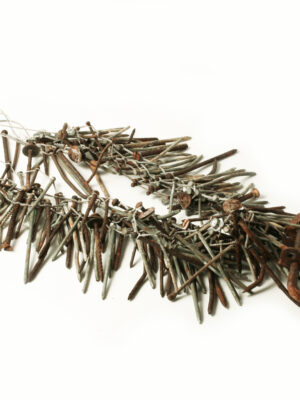
The materiality of NECKLACE creates an awareness of one’s own bodily condition and the tangled and symbiotic relationship created in the process of adornment. Rather than exploring the relationship between objects themselves, NECKLACE demonstrates Walker’s fascination with the relationship between the body and the piece of jewellery. The tactile qualities of adornment, whether through sharp nails or ungainly debris, offer a site where the body and the materiality are intersecting and interrogating each other. This reciprocal relationship between Walker’s pieces and the bodies they intrude upon reveals adornment to be a relational practice, one which considers the body as a porous and viscous being in constant dialogue with the forms around it. Through this exchange, the myth of the autonomous, pure, human form is disrupted and a more complex truth emerges. Within this reality, all forms are interconnected and the body becomes an assemblage of the human and non-human working in a tense harmony.
Each of Walker’s pieces articulates a different dimension of the radical world she has created through her practice. In this reality, time, material and identity are emancipated from traditional binaries as the moral paradigms of Western adornment are explored and transgressed. These objects shrug off the promises of beautification, instead proposing definitions of taste grounded in radically new visual languages. In her own words, Walker’s practice seeks ‘the differences between an acceptable notion of beauty or stereotype, and something else – the search for an aesthetic that we hardly ever see, but nevertheless perhaps recognise. I don’t want to make pieces that are easily steered through our established channels, I want people to be forced to work on new syllogisms, analogies and positions’³.
‘Walker explores the body as a site of interrogation where relationships between the self and the adornment can be reconfigured.’
This methodology provides objects of adornment with their own agency, stretching them beyond fixed aesthetic categories. Walker explores the body as a site of interrogation where relationships between the self and the adornment can be reconfigured. This is particularly significant within the context of Aotearoa, where jewellery and adornment exist within a complex history of Māori and Pākehā (non-Māori) cultural exchange and negotiation. While Walker’s pieces do not reference whakapīwari (Māori adornment), her work is undoubtedly informed by her roots in Aotearoa and the complex legacy of indigenous and European making practices throughout our nation’s art history.
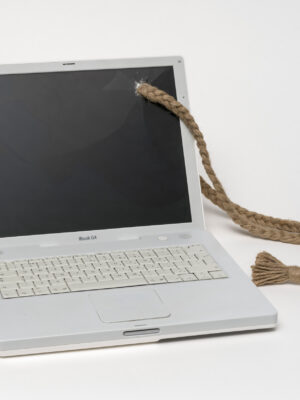
In this way, Walker’s engagement with alternative forms of adornment could be understood as a culturally informed interrogation of Western hierarchical methodologies. Although operating in different spaces, the decolonial visual languages articulated by Māori practitioners offer a liberatory alternative which is informative to both Māori and Pākehā artists. Through this framework, Walker’s practice disrupts conventional balances of power by providing objects with the ability to challenge and discomfort. In doing so, she demonstrates that our identity frameworks are neither stable nor inherent. These subversions reflect the complexities of occupying a space between cultures, using adornment as a means through which questions of beauty, autonomy and power can be made visible.
Across Walker’s practice, the undesirable takes precedence. The objects which make up her warped assemblages represent a vision of the world in which identity is an ongoing negotiation. For Walker, time loses its sense of linearity as waste is continually reimagined and reborn. In an era when political and social conservatism is dictating public discourse and shaping the definitions of identity, Walker’s work becomes all the more vital. Within each representation of the liminal, grotesque and challenging, there lies a piece of an emancipatory future; a grey area in which disobedience, deconstruction and transmutation are celebrated. Through these radical new paradigms, Walker’s practice moves beyond limitations and explores the redemptive and transformative possibilities of craft.
Footnotes
¹ Plato, Greater Hippias (Cambridge, MA: Harvard University Press, 1926).
² Immanuel Kant, Critique of the Power of Judgment (Cambridge University Press, 2000).
³ The National, Lisa Walker, https://thenational.co.nz/artists/lisa-walker/
Bibliography
Kant, Immanuel, Critique of the Power of Judgment, edited by Paul Guyer, translated by Paul Guyer and Eric Matthews (Cambridge University Press, 2000).
Plato, Greater Hippias, translated by H. N. Fowler, Loeb Classical Library 167 (Cambridge, MA: Harvard University Press, 1926).
The National, Lisa Walker, https://thenational.co.nz/artists/lisa-walker/ (Accessed: 01 April 2026).
Sophie Elborough is an Aotearoa-based archivist, researcher, and writer whose varied practice always gravitates back towards the esoteric, ephemeral, and untold. She explores remembering and collecting as political acts, seeking to create alternative archives and unearth forgotten stories. IG: @sophieelbb
Cover Image: Lisa Walker, What Karl didn’t take with him, 2010, image courtesy of the artist.
All images were provided by the author, and we publish them in good faith; responsibility for rights and permissions rests with the author.
This year we’re diving deep, with Underworld as the main theme. We invite our writers to find beauty and (re)generative power in the decaying, slimy and grotesque, in the things that have been relegated to the ‘underworld’ but which are immensely life-giving. We welcome a range of writing anchored in research and distinctive points of view, including short-format essays, articles and interviews.
Guest edited by isabel wang pontoppidan, Danish-Chinese writer, artistic researcher and jewellery maker based in Amsterdam. Her practice is multi-pronged, combining writing, performance, research and jewellery in a variety of overlapping cross-sections.
In 2026, you can look forward to a new series of 12 articles released on a monthly basis, this time on the topic of the Underworld. Our articles remain open to all readers for one month from the date of publication and thereafter become part of the CO archive available to subscribers only.