When raw material becomes an object, it enters systems of ownership, value and preservation. Objects can be collected, exchanged, inherited and protected because they appear capable of remaining the same. Yet this stability is always provisional. Surfaces oxidise, fibres weaken and organic substances deteriorate, continually disrupting the permanence imposed upon them. Ownership depends upon the promise of stability, but material unsettles this promise from within. This raises a broader question: can the object ever be fully absorbed into the logic of possession, or does its instability continually generate strategies that resist it?
If ownership depends upon the continual stabilisation of material change, the materiality becomes not merely a challenge to possession but the very condition of non-ownership. Material resists fixation into an ownable object, continually disrupting the subject’s attempt to secure, possess or stabilise it as its own. It is both immediate and elusive: directly sensed, yet never fully secured. Meaning, therefore, no longer appears as a stable presence but emerges through continual slippage, hesitation and reconstitution. Rather than a perceptual disturbance to be overcome, this unease becomes productive, exposing the limits of sensory certainty and opening new possibilities for thought.
‘Behind every apparently permanent object lies an ongoing labour of repair, adjustment and care, revealing permanence itself to be a carefully maintained fiction.’
Few artistic practices expose materiality’s contradictions – and its possibilities – more clearly than Eva Hesse’s. Working in New York during the 1960s, Hesse embraced materials such as latex, fibreglass, resin and cloth that transform, deteriorate and resist stable form. Although her sculptures now occupy museum collections around the world, the very materials from which they are made continue to unsettle the permanence and preservation upon which those institutions depend.
The conservation of Hesse’s work makes this tension especially visible. Museums attempt to stabilise objects through climate control, restoration and carefully managed systems of maintenance, yet these efforts also reveal a fundamental contradiction: were material truly stable, such interventions would be unnecessary. Conservation, therefore, does not eliminate material instability but continually negotiates with it. Behind every apparently permanent object lies an ongoing labour of repair, adjustment and care, revealing permanence itself to be a carefully maintained fiction.
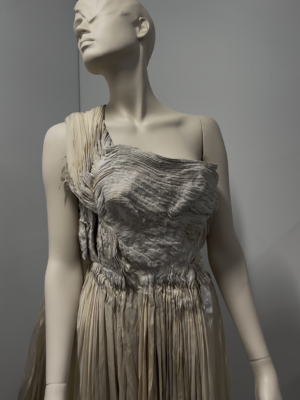
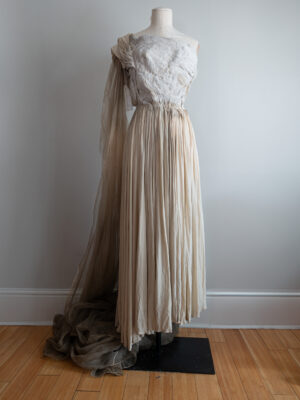
Standing before Hesse’s sculptures, material appears as if fully given – something seemingly within reach, almost tangible. Amber-toned latex hangs in uneven folds; pale fibreglass gathers into thick, irregular skins; wrinkled and translucent surfaces appear soft enough to invite touch. At times, these materials seem slack, sticky or weighted by their own fragility. The sculptures evoke a powerful sense of corporeality, inviting an intimate sensory encounter where tactile experience presents itself with forceful immediacy.
Yet this immediacy never settles into certainty. Confronted with the present surface, the viewer is compelled to reconstruct earlier material states – compression, congealing and separation – through tactile imagination. Although hardened, the surface retains traces of an absent mould and the fluid processes from which it emerged, compressing multiple temporalities that cannot be grasped simultaneously but remain deferred. Tactility, therefore, does not culminate in immediate sensory contact but unfolds through projection and withdrawal1.
Ultimately, Hesse’s sculptures reveal touch as simultaneously immediate and absent, transforming sensory experience into productive ambiguity. This ambiguity does not resolve into stable meaning; rather, it enables meaning to emerge through instability and deferral. As Alex Potts observes, sculpture often draws viewers in with the promise of sensory coherence even as it frustrates that desire2. What appears available to touch continually exceeds attempts to secure it, exposing the instability not only of perception but of possession itself. Material becomes not an obstacle to meaning but its very condition of possibility. Hesse’s work thus does not simply resist possession; it exposes possession as a fiction sustained by the impossible desire for perceptual stability, rendering ownership itself fundamentally unstable.
If Hesse reveals the instability underlying the ownable object, contemporary practices working with bodily and ephemeral materials extend this question into new conditions. Sweat, tears and bodily residues appear deeply personal, seemingly inseparable from the individuals who produce them. Yet once transformed into material form, they begin to exceed individual ownership, moving between body and environment, intimacy and distance, presence and absence.
‘Hesse’s sculptures reveal touch as simultaneously immediate and absent, transforming sensory experience into productive ambiguity. This ambiguity does not resolve into stable meaning; rather, it enables meaning to emerge through instability and deferral.’
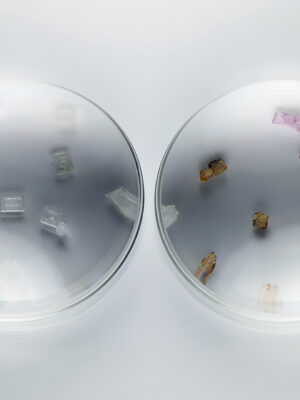
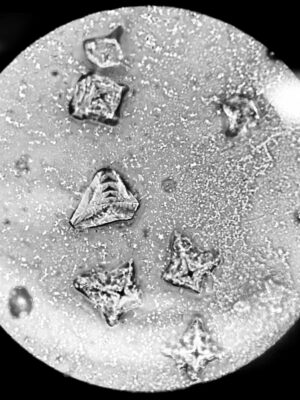
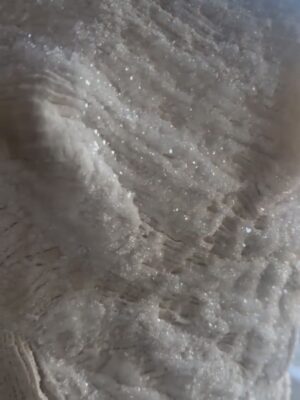
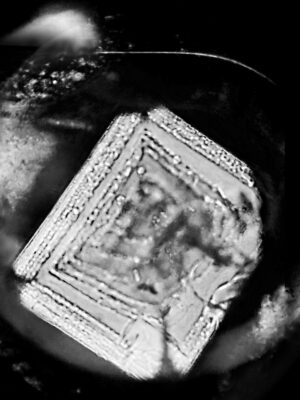
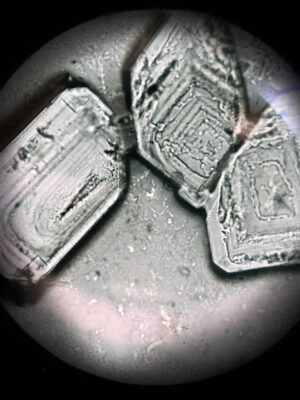
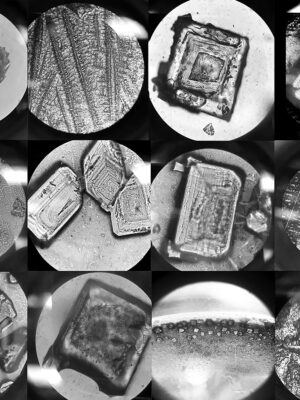
The work of Alice Potts offers one response to this condition. Across her garments and wearable pieces, sweat is transformed into delicate crystalline formations that spread across textile surfaces like frost, salt deposits or mineral growth3. Tiny white crystals gather across fabrics as though the body had begun to mineralise itself. At first glance, these structures appear almost magical. Yet they originate from one of the most ordinary and ephemeral substances produced by the body. Potts collects individuals’ sweat using clean, body-safe absorption materials during physical activity before carefully extracting and preserving it for integration into the final works. What is normally invisible becomes visible. What would usually evaporate is momentarily given form.
The crystals remain fragile. They may dissolve, fracture or gradually disappear. Material here does not persist as a stable entity but remains a trace, oscillating between presence and disappearance. Potts’s work foregrounds the porous nature of the body and the inevitability of what it leaves behind. The body is revealed not as a self-contained unit but as a site of continual exchange with its environment. The resulting works appear suspended between adornment and erosion, preservation and loss. They invite possession even as they reveal the instability of the very materials from which they are made. Ownership consequently becomes inseparable from disappearance: what is acquired is not a stable object but an ongoing material process whose eventual dissolution is already inscribed within it.
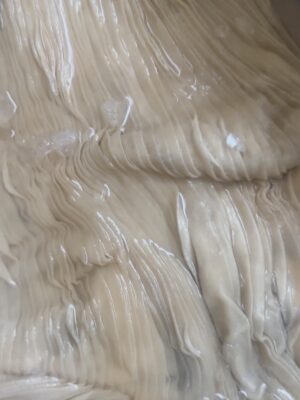
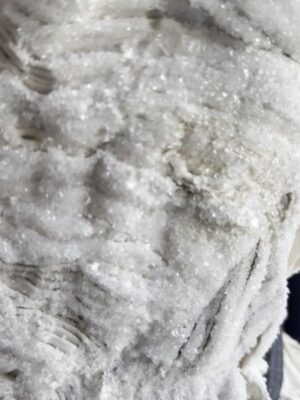
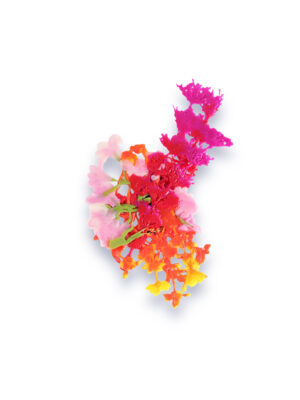
A similar tension emerges in the work of Judit Fritz. Drawing on tears, bodily fluids and other transient substances, Fritz focuses on the moment at which liquid matter begins to take form. Crystallised tears accumulate into delicate structures that appear at once deeply intimate and strangely impersonal4. Their surfaces shimmer and harden, yet they continue to bear traces of their former fluidity. What unfolds is not emotion made visible in any straightforward sense, but matter caught in the midst of transformation.
The emotional specificity of the tears is deliberately withheld. We do not know whose tears they are or what story they belong to. Instead, the work shifts attention from individual experience to material process. As bodily substances accumulate and become visible, they cease to function solely as personal traces and begin to reveal broader conditions of exchange between bodies, environments and time. Like Hesse’s latex and Potts’s crystallised sweat, these materials resist stabilisation, moving between liquid and solid, visibility and disappearance, intimacy and distance. Material thus remains suspended between objecthood and process, refusing to fully settle into either condition.
These practices nevertheless encounter pressures of restabilisation within systems of commodification. Once given enduring form as works, ephemeral substances such as sweat, tears or bodily fluids are reconfigured as ownable entities. Instability does not disappear; rather, it becomes instrumentalised. What initially appeared resistant to ownership may itself become a source of aesthetic and exchange value. Resistance, in other words, can be absorbed into the very structures it seeks to unsettle.
Even so, this incorporation remains incomplete. Material continues to introduce fractures into the logic of ownership. Rather than simply repeating Hesse’s material strategy, the contemporary practices discussed here reconfigure it under new economic and cultural conditions. Instability, therefore, endures not as a force that negates ownership, but as one that continually exposes its limits. Ownership consequently emerges not as a fixed state but as an ongoing process of negotiation between material transformation and the persistent desire to stabilise it.
Sweat, tears, residue, corrosion, decay occupy an ambiguous position within systems organised around permanence, value and possession. Frequently dismissed as waste or degradation, they nevertheless reveal material in its most active state. Rather than opposing transformation, they depend upon it, pointing towards a conception of material life grounded not in permanence but in continual change.
‘Every object depends upon practices of ordering, preservation and ownership that seek to stabilise matter into recognisable forms. Yet material continually exceeds these efforts, moving according to its own temporalities of corrosion, evaporation, crystallisation and reformation.’
Seen in this light, the Underworld is not merely a metaphor for what lies beneath systems of value. It names the material dimension that those systems can never fully absorb. Every object depends upon practices of ordering, preservation and ownership that seek to stabilise matter into recognisable forms. Yet material continually exceeds these efforts, moving according to its own temporalities of corrosion, evaporation, crystallisation and reformation. The subterranean therefore designates not a separate realm but the persistent excess of process over permanence. What appears marginal or undesirable from above is precisely where material proves most dynamic below.
Ownership thus emerges as a sustained negotiation with material instability. Objects may be collected, preserved and exchanged, yet the materials from which they are composed remain active participants in their own transformation. Hesse, Potts and Fritz each demonstrate that ownership is inseparable from the instability it seeks to manage. The fiction of permanence survives only through continuous acts of conservation and repair. Material may be owned, but it can never be fully possessed. What ownership confronts, ultimately, is not the possibility of change but its inevitability.
Footnotes
1 Alex Potts, ‘Tactility: The Interrogation of Medium in Art of the 1960s’, Art History 27 (2004), 291–292.
2 Alex Potts, The Sculptural Imagination: Figurative, Modernist, Minimalist (Yale University Press 2000), 34–35.
3 Barbican, ‘Dirty Looks: Exhibition Guide’.
https://www.barbican.org.uk/exhibition-guides/dirty-looks-exhibition-guide
[accessed 03 April 2026].
4 Vica Gábor, ‘SWEAT AND TEARS… CRYSTALLISED: Interview with Judit Fritz’, Current Obsession (2021).
https://current-obsession.com/sweat-and-tears-crystallised/
[accessed 06 April 2026].
Bibliography
Barbican. “Dirty Looks: Exhibition Guide.” https://www.barbican.org.uk/exhibition-guides/dirty-looks-exhibition-guide
Gábor, Vica. “SWEAT AND TEARS… CRYSTALLISED: Interview with Judit Fritz.” Current Obsession, 2021. https://current-obsession.com/sweat-and-tears-crystallised/
Potts, Alex. The Sculptural Imagination: Figurative, Modernist, Minimalist. New Haven: Yale University Press, 2000.
Potts, Alex. “Tactility: The Interrogation of Medium in Art of the 1960s.” Art History 27 (2004), pp. 282–304.
Cover Image: Judit Fritz, Corpus Gemmologica, 2023, Photo by Albin Josephson
All images were provided by the author, and we publish them in good faith; responsibility for rights and permissions rests with the author.
This year we’re diving deep, with Underworld as the main theme. We invite our writers to find beauty and (re)generative power in the decaying, slimy and grotesque, in the things that have been relegated to the ‘underworld’ but which are immensely life-giving. We welcome a range of writing anchored in research and distinctive points of view, including short-format essays, articles and interviews.
Guest edited by isabel wang pontoppidan, Danish-Chinese writer, artistic researcher and jewellery maker based in Amsterdam. Her practice is multi-pronged, combining writing, performance, research and jewellery in a variety of overlapping cross-sections.
In 2026, you can look forward to a new series of 12 articles released on a monthly basis, this time on the topic of the Underworld. Our articles remain open to all readers for one month from the date of publication and thereafter become part of the CO archive available to subscribers only.