I’ve found myself entranced by videos of them online, pausing to examine the pink worms wriggling in crumbly, saponified fat.1 Minotaurs of the modern world, fatbergs are disgusting, inconvenient and expensive to get rid of. Ironically, the word ‘berg’ means mountain in German. Situating the fatberg, made of tonnes of non-biodegradable material, within landscape imagery warps its image somewhat. Nevertheless, most people refuse to look at them, let alone contend with the fact that they are our offspring.
The grotesque physicality of these spectral slugs haunting underground sewage systems situates them within the realm of the abject. And while these creatures repulse and terrify their makers, they also open up a window into how humans confront the biological and synthetic waste that they are surrounded by. Furthermore, the bacteria-ridden deposits invite us to consider the ways in which we interact with disease and decay that both help and hinder our survival.
Julia Kristeva’s seminal work on abjection offers a useful lens through which to view these monsters in the abyss. Abjection, Kristeva describes, is the particular horror of encountering something which threatens the coherence of the human body.2 She details ‘the repugnance, the retching that thrusts [her] to the side and turns [her] away from defilement, sewage, and muck.’3 Abjection also arises when something moves beyond meaning; she gives death as an example of what is permanently thrust aside in order to live. The abject, Kristeva argues, is what fades the border between life and death.
Fatbergs’ fleshy bodies coagulate from waste products of modern-day living. The discarded items we happily push from our minds return to the surface, replete with our excrement, vomit and blood. These fatbergs are a warped mirror of the human: teeth, jewellery, condoms and anabolic steroids are mired in solidified fat, along with chairs and tennis balls. To me, they pose a Frankensteinian threat, reminding us not only of the terrors we can create, but also that what we hold to be human is porous and leaking. They are us, and pose a persistent, if unwanted, reminder of the less savoury parts of ourselves, the things we lose, or try to get rid of.
Kristeva specifies that ‘It is…not lack of cleanliness or health that causes abjection but what disturbs identity, system, order.’ With their gruesome stench and disturbing regurgitation of used cleaning materials, rancid grease, excrement and toilet paper, fatbergs starkly expose the inability to process the enormous amount of effluence cities produce every day. Excrement and physical waste products, both inorganic and organic, clog up the ancient pipes, taking weeks to unblock and causing flooding and environmental contamination.4 London is a prime example: the rapid construction of high-rise buildings has put even greater pressure on archaic Victorian sewage systems. Inhabitants pray the Super Sewer, recently completed, will keep the monsters at bay.
I devoured Daisy Lafarge’s Lovebug, and was fascinated at the way she examined the experience of abjection in conjunction with disease and microbes. She traces the history of the body imaginary, including the Christian conception of the human as flesh, blood and spirit then to humans as warriors constantly battling against the unsavoury insistence of bacteria and viruses. Lafarge points out ‘a moment in the heady bacteriomania of the late nineteenth century when every ailment was believed to be of bacterial origin.’5 In modern times, we accept that our bodies live in symbiosis with vital bacteria and microbes, though fight against symptoms and try to conceal them where possible. Kristeva’s understanding of the abject as a disruption of the coherence of the body comes into play here. From spluttering colds to explosive stomach bugs, the gross symptoms and disruption of bodily processes caused by infections are undoubtably abject.
Many diseases are potentially life-threatening. Kristeva writes that the corpse ‘is the utmost of abjection. It is death infecting life.’6 The simultaneity of microbes being both vital to and potentially fatal to life is a fascinating complex of the human condition. And I believe the notion of ‘death infecting life’ is reproduced in the composition of fatbergs. Single-use wet wipes, ironically advertised as killing 99.9% bacteria, contribute significantly to the gradual blockage of sewers, while fatbergs have been found to contain ‘superbugs’, bacteria that are antibiotic resistant.
My obsession with these leviathans perhaps comes from their strange combination of cream, gravies, nappies and tissues, mixed with billions of bacteria. I enjoy experiencing the sensation of abjection, and as an avid researcher of provocative fashion that plays with the grotesque, I often roam platforms for artists that dare to disgust. In my searches, I found two artists inviting me to wear slimy gloves, hairy brooches and mouldy necklaces. Of course, I was instantly obsessed.
I first found Helena Stölting through Depop, and was instantly enamoured by a pair of lurid-green slime coated heels. As I scrolled down the page, breathless, through slime and sludge-inspired wearable art, I was filled with a sticky joy at the textures of her work. Wet, amorphous globs and the bulging growths, alongside teeth and hair, feature across her designs. She aims to make the disgusting sexy, by transforming deadstock fabrics and secondhand shoes into grotesquely alluring pieces dripping with gunk, and ones that recall abject diseases.
One of her pieces is a dress made from lime green fabric that features bubonic growths on the torso.7 It recalls the Plague, the deadliest outbreak of disease to be recorded, that occurred in Europe, Africa and the Middle East during the fourteenth century.8 With between 20–30 million estimated deaths in Europe, corpses piled up so quickly they couldn’t be buried fast enough and were left, stinking and dreadful for those living near them. The tension between beauty and the abject exposed in this bubonic motif crops up repeatedly in Stölting’s pieces, through shimmering pustules and sludge. Wearing these pieces signals a refusal to hide and suppress the abject and instead, to celebrate it, and I find this exciting and inspiring.
Stölting’s drip tops are a slick of greasy, three-dimensional oil on fabric, in lurid green or petrol black, which remind me of crude oil and pond sludge, respectively. She’s particularly interested in ‘aesthetics that make the viewer so excited that they can’t pull away, and [she] found this concept the strongest when someone is extremely disgusted by something.’ Slime, an ambivalent texture recalling vomit, spit, pus and discharge all at once often evokes disgust among people. I love the shiny, gooey effect, finding slime both provocative and sensuous. I lust after the hair bikini, bright green fabric printed with wet-looking straggly hair that speak to the unwanted remains in the bath, post shower.
The more I sink into Marin Neuhard’s artworks, the more I want to stay festering within them. Many of them investigate the natural phenomena of rotting in fruit and household objects. They draw attention to the essential, inevitable and indelicate process of decay, but I found myself reassessing the shame these processes bring to humans.9 One piece is a string of strawberries in progressive states of decomposition, culminating in a withered, shrunken fruit covered with mould. I’ve always been struck by fruit’s fall from grace as it begins to decompose. This beloved muse evokes so much distaste once it begins to wrinkle, discolour and putrefy. But a piece of fruit bursting with bacteria and fungi is also a site of coexisting realities, just like the fatberg. To a human, they symbolise decay and death. On closer look, however, fruit and fatbergs are full of life, albeit of a different kind, and this vision is abject and powerful. Neuhard’s work draws death and degradation, so firmly pushed out of mind or into the bin, onto the skin. The contact with these fearful processes invites us not to run away from the inevitable slide into decay, but to adorn ourselves with it; to be glad at its ability to keep life flourishing.
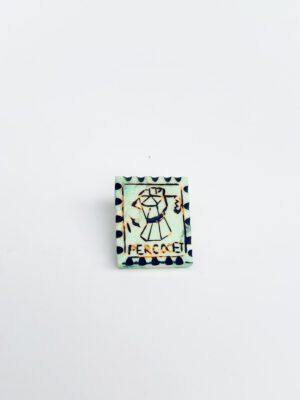
One of my favourite pieces of Neuhard’s is a brooch fashioned to look like a bar of soap, but one covered in excessive amounts of hair. This piece contains another fascinating contradiction: a tool we use to literally shed dirt and unsavoury smells from our body, when covered with waste like old hair, becomes an object of revulsion. Soap embodies purity, yet here it has been corrupted by the unstoppable force of decomposition and the fall of debris from our bodies. It gleams, pearlescent and flesh-like. I’m drawn to the duality of showers being both sites of cleanliness and of mould and waste, and Neuhard’s gorgeously mildew-flecked cushion earrings swing us into the gross and anxiety-inducing territory of the dreaded and toxic black mould.
Neuhard tells me that rotting and mould are ‘naturally so beautiful and visually complex, but avoided due to a mixture of physiological threat and social standards of disgust.’ She hopes to let the audience ‘indulge in intimate abject curiosity, revelations of beauty, without physiological threat or shame.’ As I stare at her work, delighted by speckled fabric and hairy soap, I’m reminded that my squeamishness can be transformed into a curiosity towards different biological processes happening all the time, and all around me.
Abjection can be an uncomfortable sensation. Disgust and aversion accompany the horror at that which beckons death and decay. But it can also provide relief through a greater understanding of the process of putrefaction. I see the beauty in shiny slime, and cobwebby hair; even in fatbergs, which contain talismans of modern life. These two designers offer a new kind of interaction with slime, hair and pustules, and I would love to wear these pieces, to participate in an aesthetic that is more accepting of the inevitable decline and return of life, that overlaps and overturns itself. Stölting and Neuhard invite the wearer to transform the abject boundary of deathly, decaying territory into a place of both beauty and ugliness, one that is complicated and full of contradictions, but also of inspiration.
Footnotes
1 https://www.youtube.com/watch?v=3i_axpk0a7Q&t=123s
2 J. Kristeva, Powers of Horror: An Essay on Abjection, 1980
3 J. Kristeva, Powers of Horror: An Essay on Abjection, 1980, translated by Leon S. Roudiez, 1982 https://files.commons.gc.cuny.edu/wp-content/blogs.dir/20673/files/2018/02/Kristevapowersofhorrorabjection.pdf
4 https://smartwatermagazine.com/news/smart-water-magazine/beneath-surface-rise-fatbergs-and-cost-what-we-flush-away
5 D. Lafarge, Lovebug, 2023, p.68
6 J. Kristeva, Powers of Horror: An Essay on Abjection, 1980
7 https://helenastoelting.com/
8 https://www.britannica.com/event/Black-Death
9 https://www.instagram.com/moneuhard/
Bibliography
Kristeva, J., Powers of Horror: An Essay on Abjection, 1980
Kristeva, J., Powers of Horror: An Essay on Abjection, 1980, translated by Leon S. Roudiez, 1982
Lafarge, D., Lovebug, 2023
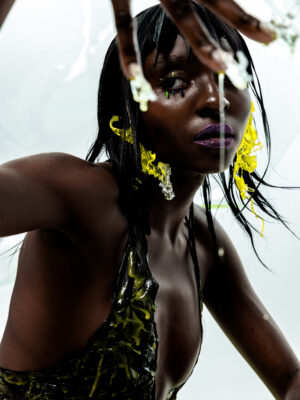
Cover Image: Design by Helena Stölting, ‘Whitney wearing Drip Dress Closeup, 2023’, Photo by Marlen Stahlhuth, via www.instagram.com/aneleh.gn/
All images were provided by the author and we publish them in good faith; responsibility for rights and permissions rests with the author.
This year we’re diving deep, with Underworld as the main theme. We invite our writers to find beauty and (re)generative power in the decaying, slimy and grotesque, in the things that have been relegated to the ‘underworld’ but which are immensely life-giving. We welcome a range of writing anchored in research and distinctive points of view, including short-format essays, articles and interviews.
Guest edited by isabel wang pontoppidan, Danish-Chinese writer, artistic researcher and jewellery maker based in Amsterdam. Her practice is multi-pronged, combining writing, performance, research and jewellery in a variety of overlapping cross-sections.
In 2026, you can look forward to a new series of 12 articles released on a monthly basis, this time on the topic of the Underworld. Our articles remain open to all readers for one month from the date of publication and thereafter become part of the CO archive available to subscribers only.