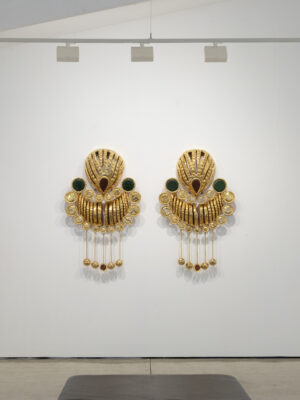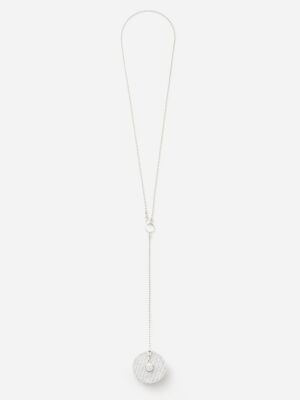
This year marked the opening of the 61st Venice Biennale, otherwise known as the ‘Olympics of the contemporary art world’, and Current Obsession had the pleasure of attending during its opening weeks. Alongside the excitements of the Biennale’s exhibitions, an inaugural presentation by the freshly established Fondazione Dries Van Noten offered a perfect excuse to meander among Venice’s palazzos in search of inspiring craftsmanship from established and emerging creators alike.
Housed inside Palazzo Pisani Moretta, a three-storey aristocratic residence on the Grand Canal with a Venetian Gothic Fiorito façade, the exhibition brought together more than 200 works. Rather than arranging them by theme, medium or chronology, the presentation allowed the historic architecture to become a part of the exhibition’s narrative: contemporary works unfold in dialogue with frescoed ceilings, Murano chandeliers and the ornate details of the palazzo’s interiors.
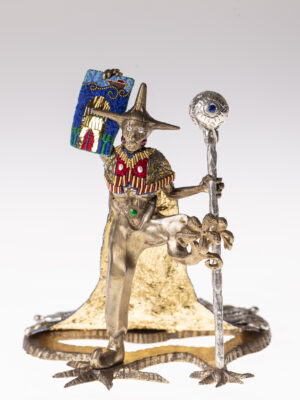
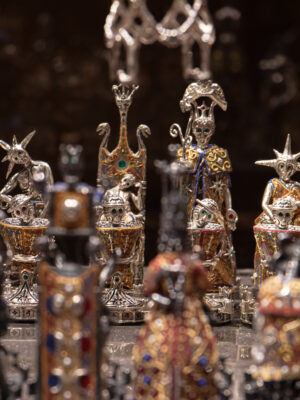
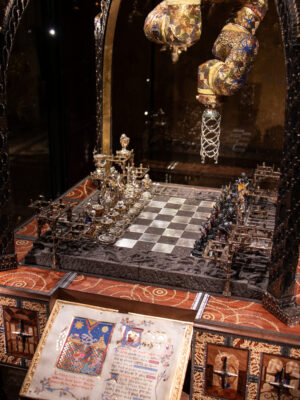
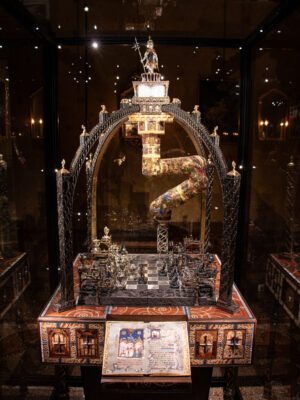
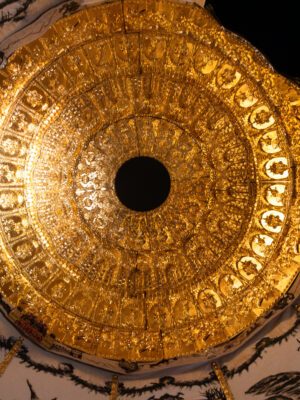
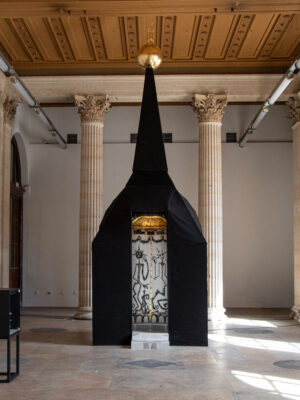
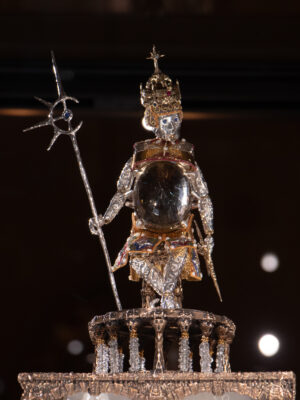
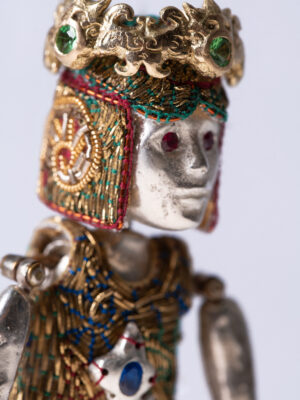
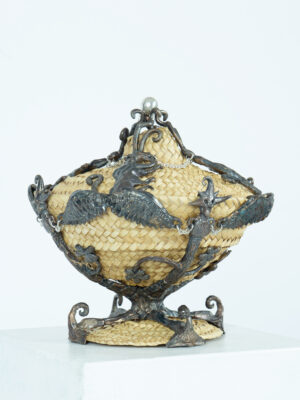
It was there that we encountered ‘L’Échiquier des Songes’, or ‘The Chessboard of Dreams’, a multidisciplinary installation by Joseph Arzoumanov centred on a game of chess played by a robotic arm powered by artificial intelligence. Its 32 chess pieces, cast in blackened silver and adorned with gold embroidery and precious stones, stand upon a board of inlaid wood and Armenian volcanic stone. Above it rises a mother-of-pearl temple concealing a small bottle of perfume, while music composed by the artist’s grandfather accompanies the game. Simultaneously ancestral and futuristic, the work seems to be suspended somewhere between an heirloom from an imagined civilisation and an artefact from a future yet to come.
Fittingly, the inspiration for the piece comes from musings on the past and destiny. Inspired directly by the love story of Arzoumanov’s grandparents, the games played by the robotic arm have one ultimate goal: for the White King and Black Queen to meet at the end. Brought together by an unlikely series of events, the story of the artist’s grandparents provokes a unique meditation on chance, destiny and the innumerable paths that might lead two people towards one another.
The mastermind behind this extraordinary game of chess, Joseph Arzoumanov, is a 24-year-old French-Armenian multidisciplinary artist whose practice spans embroidery, goldsmithing, sculpture and, more recently, robotics and artificial intelligence. A recent graduate of École Duperré, Arzoumanov has developed a distinctive visual language in which meticulous craft, richly ornamented objects and fantastic stories that are at once deeply personal and entirely imagined coexist.
After meeting Joseph in the Palazzo Pisani Moretta, we invited him to talk about his craftsmanship, where precious stones meet robotics, family history meets fantastical worlds, and childhood dreams are given physical form.
Dominika Szmidt: You’re only 24, and in a few years you’ve gone from studying embroidery at École Duperré to landing the centrepiece of Dries Van Noten’s first foundation show in Venice. Walk me through how you got here.
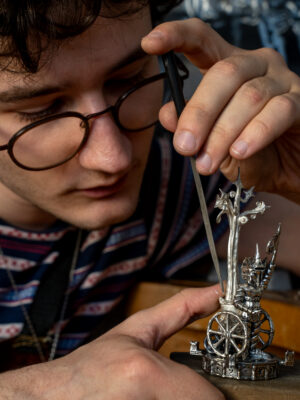
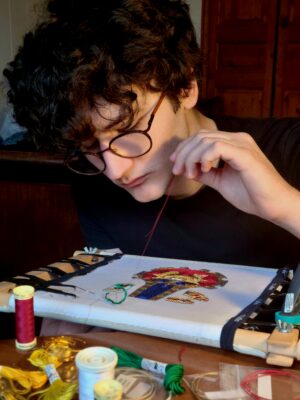
Joseph Arzoumanov: I’m a goldsmith, gold embroiderer, and sculptor. It all started at École Duperré, a fashion school in Paris, where I learned gold embroidery. From there, religious sculptural embroidery slowly led me toward metallic sculpture, and eventually toward jewellery. So it began in fashion, but I’m really more of a sculptor – sometimes I make things related to the body, like jewellery, or even garments.
How did I end up at the Biennale? Dries Van Noten asked me what my ongoing projects were – he was interested to include them in the opening of his foundation at Palazzo Pisani Moretta. I showed him a raw version of a chess game I’d been making for two and a half years, and he helped me finish it in time for the exhibition. That piece is L’Échiquier des Songes, ‘The Chessboard of Dreams’, my biggest work so far.
DS: What led you to choose art in the first place, to go to fashion school? Was that something you’d been drawn to throughout your life?
JA: No – I was at a school in Paris split between science and music, in special classes. I was supposed to become a violinist or a mathematician. Then, when I was sixteen, my grandmother taught me how to sew, and I launched my first small brand at sixteen or seventeen. That’s when I knew I wanted to do fashion. It was simply the first skill I’d learned.
But the music is the base. It’s my main inspiration for everything I craft. Music is something you feel and express, but it isn’t figurative – it’s nothing more than feeling, really. What I try to do is make it real.
I think I’m just passionate about craftsmanship. I went to various countries and learned different know-how: white embroidery in India and Uzbekistan, different types of braiding in the United Arab Emirates, stone carving in Armenia.
I use craftsmanship for a narrative, a very logical narrative. Each artwork I make is part of the same world. Everything is related, with bridges everywhere.
‘The music is the base. It’s my main inspiration. Music is something you feel and express, but it isn’t figurative – it’s nothing more than feeling, really. What I try to do is make it real.’
DS: Could you tell me about this world that you’re creating?
JA: I think it’s the same one I was playing in when I was a child. I used to play, to draw a lot of different universes. And also to play a lot with Lego. For me, crafting a jewel is like playing Lego. I was building palaces in Lego, and now I build bronze and silver palaces in real life.
I always dreamed of becoming an archaeologist. But then I understood that maybe I wouldn’t find the tomb of Tutankhamun, I wouldn’t find lots of treasure. In the eyes of a child, a treasure has to be precious, full of gold and silver. And so, doing gold embroidery at fashion school, I understood that it was possible to craft that treasure with my own hands.
It’s a shortcut to fulfil my childhood dreams. To create the treasure I dreamt of discovering.
DS: What’s the starting point for you to begin creating? Is it more of a conceptual decision, or is it something that starts with a kind of spark, and the piece grows out of that?
JA: It has to start as a spark. It stays in my mind for months, without a single drawing. I’ll talk to friends and tell them all about it. Then, sometimes a year later, sometimes just a few months, I start drawing – very roughly, just to get the basic elements down. I don’t like spending time on drawings, because a drawing is just the illustration of an idea, not the final piece.
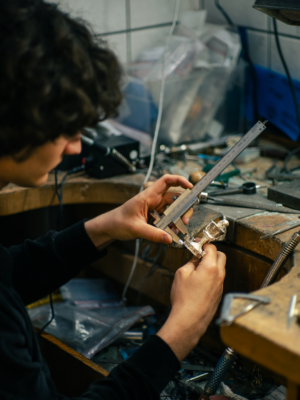
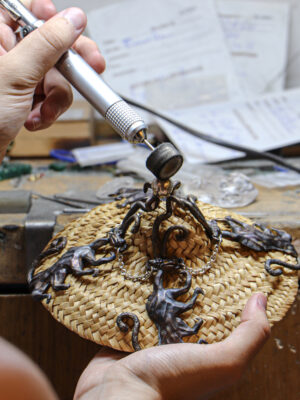
After that comes prototyping, and the whole jewellery-making process, which is very long. I learned early that if you spend months making something, really making it, it can become a treasure.
And so I’m okay with spending a lot of time, years, on artwork. Sometimes I have multiple artworks at the same time. I take the time to make it just as I want.
One mistake people make about my process is thinking that because it’s long-term – say, three years for a piece – it’s slow. It’s not. Every single day is a sprint. These pieces are so intricate, so detailed, and involve so many high-precision techniques that if I’m not moving fast every day, I couldn’t show work like this so early.
DS: You only graduated from the Beaux-Arts de Paris in 2025, and yet you were already showing work and taking part in residencies while you were technically still in school. What did it feel like to be learning, but also already so far ahead in your career at the same time?
JA: It’s exciting. My purpose has always been to be autonomous before leaving school. I also have a kind of personal doxa: do the craziest thing at the youngest possible age, just because it’s exciting. If I want to build my palace, I have to do it. I have to do everything very early.
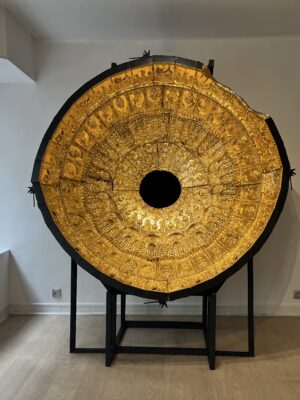
In my first two years, I was a student with no money, making projects with the school’s resources, or thanks to donors connected to the school. Then came my degree project – the Mausoleum – and that was something big, expensive to build. That’s when I understood: if I wanted to keep making big artworks, I had to make money. I had to sell. At the time, I didn’t want to do it. But I started selling jewellery while still a student, and that’s really when I became a professional, very early on. I like it – it’s fun.
DS: I think if you didn’t have enough fun, you probably wouldn’t be able to produce this much quality work.
JA: Fun is everywhere in the process. But I think the more sophisticated the work gets, the more my heart is in it – and the more painful the process becomes too. So it’s a balance. A balance between moments of total despair and moments of insane, delirious joy.
With the chessboard, sixty people worked on the piece over three years. It’s massive. But it was only in the last two weeks before the exhibition that we saw the actual result – everyone was working across ten different ateliers. Even I was making creative decisions at the very last minute. I had basic drawings, but never the final ones. I always want to do the final touch myself.
So even people working on the piece had doubts. They’d ask me, ‘Are you sure this will work? Are you sure you’ll finish it?’ And honestly, I didn’t know either – I didn’t know if I’d finish it in time for the exhibition. It was only two weeks before, when we assembled the piece, that it happened. It was so magical. I wanted to cry every day. I slept underground, right next to the sculpture, for those two weeks. I didn’t want to leave it alone, without anyone to look after it.
‘It’s all about destiny. Did my grandparents choose to meet? My answer – the answer I’m proposing – is maybe not. Maybe there’s something above. And in this delirious, fantastical world, that ‘something above’ is the robotic arm – maybe it’s the hand of a superior spirit.’
DS: Tell me more about L’Échiquier des Songes, ‘The Chessboard of Dreams’.
JA: There were several reasons that led me to make a chessboard. First, I really wanted to pay tribute to my grandparents’ love story – how they met near Leningrad, now Saint Petersburg, in the past century, while my grandmother was visiting the grave of Anna Akhmatova, the Soviet poet. It’s a very passionate love story, and I wanted to honour it.
But there were other threads too. During my travels in Uzbekistan and India, I saw very ancient chessboards – those two countries are actually where the first chessboards were ever created. I also read a book by Jean-Philippe Toussaint called L’Échiquier – The Chessboard – where he draws parallels between his own life and a game of chess. I found that comparison incredibly accurate. So I thought: why not tell my grandparents’ story through a chessboard?
And then I went on an artistic residency between Boston and New York, mostly at the MIT Media Lab in Boston.
My goal was to use new and emerging technologies in a way that let me stay creative. That’s how a robotic arm came into the piece. And that’s also how I started using AI to generate games – with one rule: the Black Queen, my grandmother, and the White King, my grandfather, have to fall in love. The AI generates games based on that rule.
That’s really how my creative process works. I meet people, and the project keeps growing – growing, growing, growing – until it hits the limit of what’s realistic. I can’t put ten automatons on the chessboard, even if I’d like to. I have an idea and every choice starts with what I actually want to do, and then I make cuts. But sometimes things I never dreamed about find their way into the work anyway, and that’s what makes the piece complex.
And really, it’s all about destiny. Did my grandparents choose to meet? My answer – the answer I’m proposing – is maybe not. Maybe there’s something above. And in this delirious, fantastical world, that ‘something above’ is the robotic arm – maybe it’s the hand of a superior spirit.
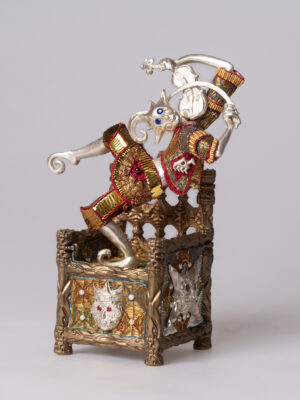
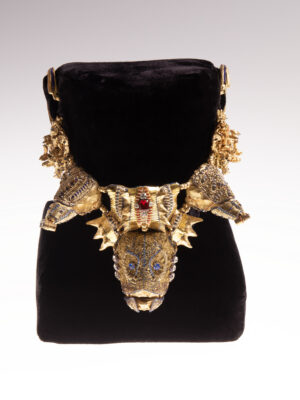
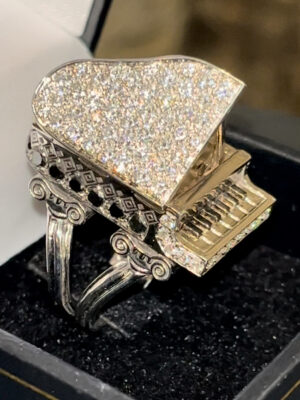
DS: What was it exactly about your grandparents’ love story that struck that emotional chord for you?
JA: My grandmother was a young French girl, and at the time it was forbidden to go into the suburbs of Leningrad – it was the USSR, and she wasn’t allowed there. So the first thing she did was something she wasn’t supposed to do. It was a snowy day, and she was alone at a train station, lost. There was only one other person at the station – my grandfather.
So they walked together through the black forest, because the Orthodox graveyards there are set in forests – almost like wild tombs among the trees. They went together to Akhmatova’s grave, and afterward to the nearby sea, which was frozen. They kissed under a tree, facing the ice.
Fifty years later, when I was fourteen, I went to that same place myself. I saw all the elements of the story I’d been hearing since I was very young, and it was so beautiful. That’s what struck me.
And on top of it – my grandfather is a classical music composer. I think the love story struck me even more than before, because I used to not really understand his music – and now I’m very into it. His music breaks my heart constantly now. He was a Soviet man who left everything for my grandmother to come to Paris. Because at the time, if you left the USSR, you couldn’t come back – you weren’t a citizen anymore. So the chessboard is also about that: the confrontation between the Western and Eastern worlds. But make it phantasmagorical, of course.
DS: Thank you for sharing this. Could you tell me how you ended up doing a residency in Boston, and what you were actually working on, skill-wise, while you were there?
JA: The residency is called Villa Albertine.
At the time I was 21, and my goal was to confront my craftsmanship with emerging technology, which I find genuinely exciting – because for me, crafting isn’t just about repeating the gestures of the past. I want to create new things, and there’s nothing better for that than putting your know-how up against technology. ChatGPT had only just been released around that time, and I wanted to be at the front of that, to own it rather than fear it. I wanted to place AI somewhere it wasn’t stealing my pleasure of creating – I still build the universe myself, but I also wanted AI to generate the narratives within it.
I tried to place it somewhere it could generate games – different versions of my grandparents’ love story. But it’s not designing the pieces themselves, because I want to do that. I have a lot of fun doing it. So that’s one way of using AI.
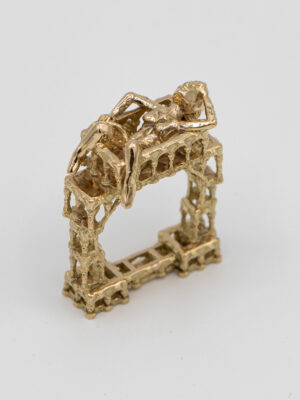
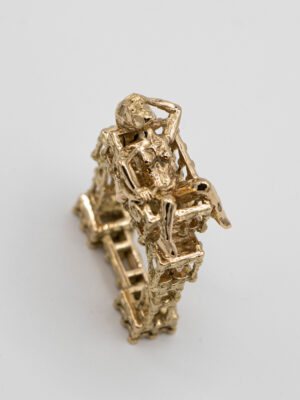
DS: Almost everything you make uses precious materials – which actually goes against the grain of what a lot of your generation is doing right now, deliberately moving towards reclaimed objects, waste, and cheap materials. What draws you to precious materials specifically? Is that deliberate, or is it just where your training naturally led you?
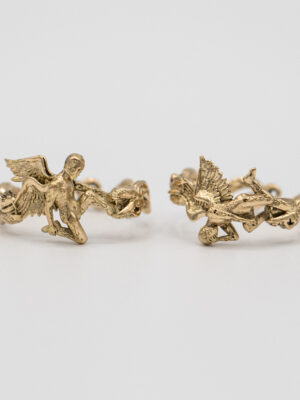
JA: It’s very deliberate. The first fashion brand I created was based on upcycling – one hundred per cent upcycled. I find that really cool, really good – you can be incredibly creative working that way. But now, when I make something, I want it to be a total artwork. And to do that, I need raw materials.
That said, I do upcycle gold – most gold used in jewellery by small artisans is broken-down gold that gets melted and remade. Some of the stones I use are dead stock, some come from old jewellery I’ve upcycled. But I always need to start from something raw. Aside from the robotic arm, which is technology, even the textiles I use are simple – plain woven cotton, linen, or silk. I can’t go further than that, because once an object already has its own identity, it can pull away from the universe I’m trying to build – it stops making sense within it.
‘Maybe one day I’ll just say, ‘Okay, it’s not my dream anymore.’ But for now, it’s a dream I have. When I was 18, I wouldn’t have considered it possible. But now that I’ve fulfilled some of my dreams, I think it is possible. I just need a bit of time.’
DS: Could you walk me through your main artistic inspirations as a whole that created this decadent and ornate aesthetic in your practice?
JA: It’s very influenced by all the palaces, churches, cathedrals, and treasures I visited in Germany, France, and Belgium when I was very young. Then we moved to Morocco, and I was drawn into Islamic art, Arabic influences – the zellige, which is Moroccan ceramic mosaic work. I think I was deeply influenced by all the mosques and mausoleums I visited as a child.
Before the war, I also went to Russia and visited Orthodox churches, which were extraordinary – hugely inspiring. I often go to the opera and theatre too, and I think the movement in the bodies I sculpt, and the stories I tell, are closely tied to opera and theatre.
Then there’s India and Uzbekistan – the Indian palaces, Indian craftsmanship, the Uzbek curves and mosaics I really love. And Bedouin culture in the Middle East as well. I process everything I see. But going back to childhood, the earliest influence of all was manga – I’m a huge fan of One Piece.
It’s also the philosophy behind it: someone doing everything to reach the One Piece, the ultimate treasure. I really love that – making friends along the way, always pushing new limits, discovering new islands, new worlds.
It’s the culture of being a little French kid – the mangas, the films, some more underground, some very mainstream, like Indiana Jones. That was a real cultural phenomenon for me. By today’s standards it’s not the most accurate portrayal, in terms of cultural appropriation – but at the time, I just watched Harrison Ford discovering these incredible treasures, and I loved it. The discovery of Tutankhamun’s tomb, that story – I loved that too. All the museums – I was just fed culture, and now I’m creating things out of everything that fed me.
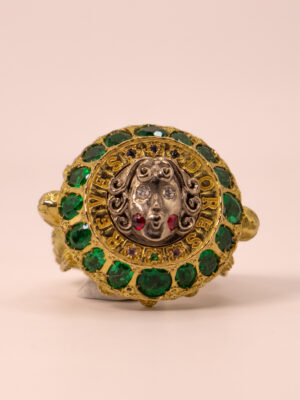
DS: Moving into the future, you have mentioned the palace. Is this something that you are actually thinking of making a reality one day?
JA: There are palaces everywhere in my work. I could say that I’ve already fulfilled this dream in a way, because I’m building little palaces in mother-of-pearl, bronze, volcanic stone, and wood. But I want to make a real one where I could live or where I could create a museum.
I just need a bit of time, resources and knowledge. I’m taking my time, like with my drawings. I don’t want to limit myself. I’ve been thinking about it for a few years, and it’s a big project, so it’s normal. Maybe I’ll think about it for another 10 or 15 years, and then I’ll buy the land and start building it. That’s the dream.
Maybe one day I’ll just say, ‘Okay, it’s not my dream anymore.’ But for now, it’s a dream I have. When I was 18, I wouldn’t have considered it possible. But now that I’ve fulfilled some of my dreams, I think it is possible. I just need a bit of time.
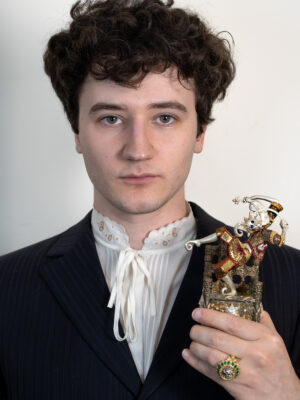
All featured images are courtesy of the artist
Cover photo: The Master of Destiny, detail, Chessboard of Dreams, 2026, Joseph Arzoumanov
We are devoting this space to an artist we have been recently obsessing over. This profile takes the form of an extended interview, following Joseph Arzoumanov’s work, process and influences.
Find out more about the artist here