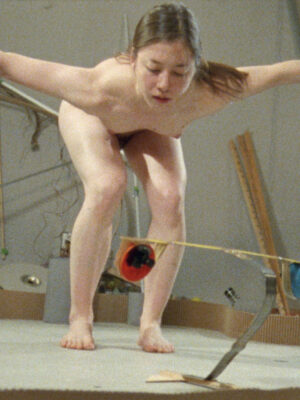
I was enjoying the grimaced expressions and uneasy arousal of those confronted with Daria Martin’s Soft Materials at the New Museum in New York. The film features two nude dancers moving with and against robotic devices in a university AI laboratory, their bodies and the machines exploring collaboration and submission.¹ People would stop dead, their faces recoiling like a child’s when trying their first salty olive. Not pure disgust; disgust is a head removed from a body, the grotesque, however, is the eyelid that flutters afterwards, an unbearable intrigue – the imagination catching on something it can’t resolve and being unable to release it and so being unable to look away. It is a disharmony in what Kant called the free play between imagination and understanding: the mind reaching for a concept that keeps slipping, recognition and refusal happening simultaneously, neither winning.²
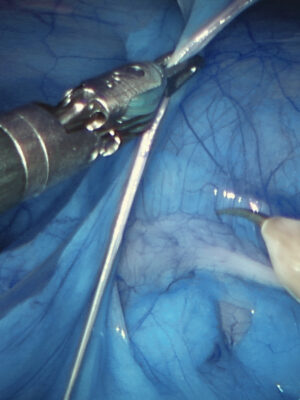
As someone who loves to gawp at surgeries, I have always been drawn to the 3M Ioban 2 Antimicrobial Incise Drape (amongst, it has to be said, most surgical tools and innovations): a rubbery square of uncanny, skin-like material applied to a patient before the first incision. It twinges a dark intellectual curiosity. A translucent film, iodine-tinted, engineered from what the manufacturer calls a low-memory material, meaning it has no resistance to the body’s contours, its function being simply to guard against postoperative infections at the site of incision. It takes on the warmth and the topology of the skin beneath it and becomes, at the surface level, almost indistinguishable from it. It seemed to me a ludicrous and vividly contemporary notion to frame such a clinical and clear surgical field, before slicing through it, revealing the unruly mess of meat space below. That layer of moderation and mediation that smacks so arbitrary and futile in trying to control a body desperate to ooze and leak.
In a recent essay on platform violence, writing about the Gaussian blur that hides mutilated bodies on social media, Alex Quicho observed that vellum was once made from animal skin – ‘apt,’ she writes, ‘to see the bloody musculature of our reality encased by a translucent effect.’³ The gesture is the same as the Ioban’s: translucent film over what cannot be shown, the bloody reality encased and made transmissible and interactable.
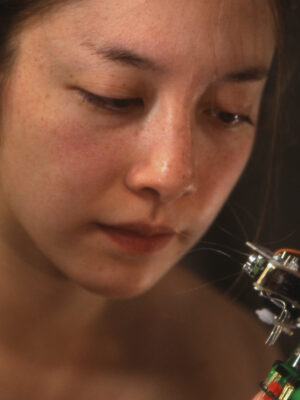
What makes it grotesque is the smudge of it all, the inseparability of drape and skin, the one thing pretending to be and morphing into another, in an interplay that feels similar to the Soft Materials film at the New Museum as part of its New Humans exhibition. The word grotesque comes from grotta – Italian for cave, itself rooted in the Latin crypta, meaning a hidden or underground place. Specifically the underground rooms of Nero’s Domus Aurea, rediscovered in the fifteenth century with their walls covered in decoration that mixed human figures, animals, plants and architectural elements in continuous transformation. Not chimeras, where you can see the join, but continuities; one thing becoming another without a clear point of departure. The grotesque was named for a place where categories dissolved underground and the name stuck because it kept describing something that wouldn’t stay in any other category. What it does, consistently, is rupture boundaries rather than transgress them, holding the contradiction open, like a wound. It is, in Frances Connelly’s formulation in The Grotesque in Western Art and Culture, a catalyst: neither element grotesque alone, but the smudge between them sets off a reaction that consumes both.⁴
‘It is what happens when a surface succeeds so completely that you forget it is a surface, and then something reminds you and you’re sickened that you were tricked.’
The drape alone is not grotesque then. The skin alone is not grotesque. The grotesque is the smudge, the moment of indistinction, the cut that passes through both surfaces without distinguishing between them. Consider the alternative: a bare knife entering bare skin is immediately horrifying and immediately resolved. The Ioban cuts through in the same stroke and suddenly you are not certain which surface was cut. The synthetic and the organic aligned, the same amber, the same yield, the same low-memory conformity to what lay beneath, and something that should have remained distinct did not. The grotesque needs the almost. It is what happens when a surface succeeds so completely that you forget it is a surface, and then something reminds you and you’re sickened that you were tricked.
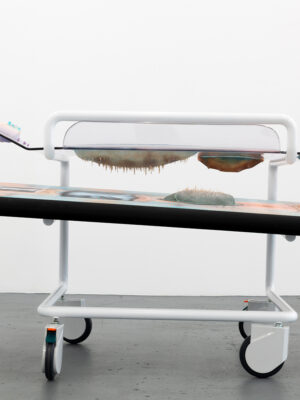
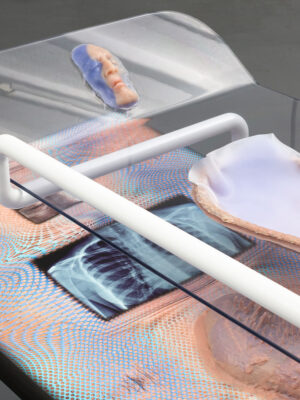
I keep returning to Tishan Hsu’s Phone-Breath-Bed 1. A gurney – that word alone, with its specific cargo of institutional dread – bearing a cast of a human face, torso X-rays pressed beneath polycarbonate, and drips of silicone that pool and cling the way flesh might if it could escape its own containment. The body is present entirely as evidence: clinical, fragmented, depersonalised, surveilled. Hsu has been working at this threshold since the early 1980s, when he took a night job at a word-processing terminal on Wall Street – among the first generation of office workers to spend long hours in front of a screen – and noticed something no one yet had language for: his body in front of the screen ‘still really counted’.⁵ Another surface, and what happened between flesh and glass was worth a life’s investigation. His wall reliefs from that period, fleshy protrusions and orifices hovering off recessed panels painted to suggest backlighting, were mapping a territory the culture would take decades to reach. In Phone-Breath-Bed 1 the investigation has become visceral and medical: silicone blobs squeezed out of surfaces, the body shown only from the clinical angle – as data, as something to be managed. The body’s impression held in synthetic material while the body itself leaks through anyway. Hsu has said he didn’t yet have the vocabulary for what he was feeling.⁶ Looking at the gurney, you understand why.
Henry Tonks was a surgeon before he was an artist. The pastel drawings he made of facial casualties at Aldershot and Sidcup in 1916 and 1917, working alongside Harold Gillies, the pioneering plastic surgeon, carry both registers without apology. Private Charles Deeks, 25, had much of his right cheek and mouth obliterated by an explosion in France in July 1916. Tonks drew him before surgery and after, the same man, the same direct gaze, the same carefully combed hair, the wound sitting in the middle of an otherwise legible face like a signal anomaly, to borrow art critic Tom Lubbock’s phrase: unreadable precisely because it appears in a context that is so ordinary.⁷ These are anti-portraits. They show the surface at the point where it can no longer guarantee an interior, where the face – portraiture’s founding premise – has been interrupted and something rawer sits in its place. Tonks called them fragments. He was proud of them and thought the general public had no business looking at them.
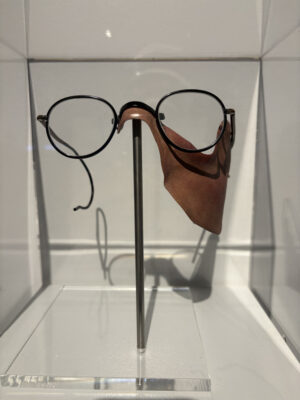
Anna Coleman Ladd was a neoclassical sculptor, trained in idealised human form. The men who arrived at her Studio for Portrait Masks in Paris had wounds too extensive for plastic surgery, faces that could not be reconstructed from within. Ladd began with a pre-war photograph of each man, studied it, then worked in dialogue with the veteran to construct a unique mask from thin galvanised copper, painted precisely to match his skin tone, attached to the face with eyeglasses.⁸ Nearly a hundred masks in a year and a half. The intention was that the men could pass in public – return to shops, to streets, to the people who had known them before. Copper is the hardest possible material to make look soft. Ladd understood this and painted it anyway, the neoclassicist working at the outermost limit of what idealised form could do, which was to hold a surface over what could no longer be shown. Tonks recorded the wound. Gillies attempted repair. Ladd covered what surgery could not fix. Her masks are grotesque in the precise sense: not because they fail, but because they almost succeed. The closer the fit to the pre-war photograph, the more insistently the imagination registers the gap between the copper and the face it was made for. The social contract – the face as guarantee of a person – was restored and simultaneously exposed as something that could be constructed in metal and paint. The men knew. Everyone who looked at them knew. The surface worked and gave itself away at the same moment.
The gaping body filled with sleek plastic ports, the interior visible on monitors, the robot operating from within.’
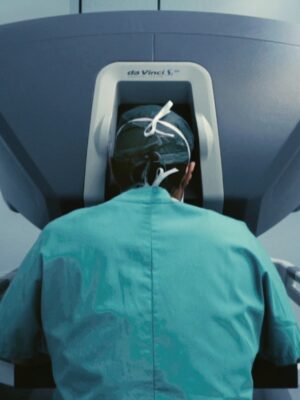
In his 2012 film Da Vinci, also shown as part of the New Humans exhibition at the New Museum, Yuri Ancarani trains his camera on the Da Vinci Surgical System, a human-operated robot used to perform complex procedures. The film flits between interior body shots and the exterior view of the machine itself: a multi-tentacled instrument of unruly kinetic energy looming over an unconscious patient, its many arms in constant, precise rotation. The flit between the two is deeply troubling, and yet the undertone to it all is a strange human empathy.⁹ The system takes its name from the very man who stood at the mouth of the cave and felt both fear and desire. Frederick Winslow Taylor, an American mechanical engineer, proposed in his Principles of Scientific Management that human labour could be decomposed into optimal units of motion, each movement calibrated for maximum efficiency.¹⁰ The Da Vinci system is Taylor’s vision completed: choreography so refined it has passed through the human body entirely and emerged as something that dances between procedures with its many arms rotating in precise unison. The gaping body filled with sleek plastic ports, the interior visible on monitors, the robot operating from within, one category dissolving into another without a visible join, which is what the original grotesque described and what it has always described. Perfectly calibrated and entirely indifferent. The drape, the mask, the robot arm, none of it changes what the body is doing underneath. It leaks anyway. It insists anyway. And the imagination, catching on that gap between the surface and what lies beneath, cannot look away.
Footnotes
¹ Daria Martin, Soft Materials (2004), 16mm film transferred to video, colour, sound, 10:30 min, exhibited in New Humans, New Museum, New York, 2025.
² Immanuel Kant, Critique of Judgement, trans. James Creed Meredith (Oxford University Press, 1952 [1790]). See also Jean-François Lyotard, Libidinal Economy (Athlone Press, 1993 [1974]); Maya B. Kronic, ‘Hyperplastic-Supernormal’, readthis.wtf (2017).
³ Alex Quicho, ‘The Gore Layer’, Spike Art Magazine (5 July 2024).
⁴ Frances S. Connelly, The Grotesque in Western Art and Culture: The Image at Play (Cambridge University Press, 2012), 1–8.
⁵ Tishan Hsu in conversation with Martha Schwendener, The Brooklyn Rail (February 2021).
⁶ Ibid.
⁷ Tom Lubbock, ‘Doing Damage’, Modern Painters, 12.1 (1999), 58–61.
⁸ Anna Coleman Ladd, Painted Metal Facial Prosthesis (1917–20), BAPRAS Collection, exhibited in New Humans, New Museum, New York, 2025.
⁹ Yuri Ancarani, Da Vinci (2012), video, colour, sound, 25 min, exhibited in New Humans, New Museum, New York, 2025.
¹⁰ Frederick Winslow Taylor, The Principles of Scientific Management (Harper & Brothers, 1911).
Bibliography
Ancarani, Yuri, Da Vinci, 2012, video, colour, sound, 25 min.
Connelly, Frances S., The Grotesque in Western Art and Culture: The Image at Play (Cambridge University Press, 2012).
Hsu, Tishan, Phone-Breath-Bed 1, 2021.
Kant, Immanuel, Critique of Judgement, trans. James Creed Meredith (Oxford University Press, 1952 [1790]).
Kronic, Maya B., ‘Hyperplastic-Supernormal’, readthis.wtf (2017).
Ladd, Anna Coleman, Painted Metal Facial Prosthesis, 1917–20, BAPRAS Collection.
Lubbock, Tom, ‘Doing Damage’, Modern Painters, 12.1 (1999), 58–61.
Lyotard, Jean-François, Libidinal Economy (Athlone Press, 1993 [1974]).
Martin, Daria, Soft Materials, 2004, 16mm film transferred to video, colour, sound, 10:30 min.
Quicho, Alex, ‘The Gore Layer’, Spike Art Magazine (5 July 2024).
Schwendener, Martha, ‘Tishan Hsu with Martha Schwendener’, The Brooklyn Rail
Jake Buckley (b. 1991) is a London and New York-based designer, writer and jeweller who practises under the pseudonym Leonardo Disaster. He graduated from the Royal College of Art in 2023, where his practice moved across sculpture, garment-making, editorial design and immersive environments. His work investigates the relationship between technology, ideology and the body. IG: @jakebuck @leonardo_disaster Substack: Jake Buckley
Cover Image: Yuri Ancarani, Da Vinci, 2012. Video still. Courtesy Studio Ancarani, ZERO…, Isabella Bortolozzi Galerie.
All images were provided by the author, and we publish them in good faith; responsibility for rights and permissions rests with the author.
This year we’re diving deep, with Underworld as the main theme. We invite our writers to find beauty and (re)generative power in the decaying, slimy and grotesque, in the things that have been relegated to the ‘underworld’ but which are immensely life-giving. We welcome a range of writing anchored in research and distinctive points of view, including short-format essays, articles and interviews.
Guest edited by isabel wang pontoppidan, Danish-Chinese writer, artistic researcher and jewellery maker based in Amsterdam. Her practice is multi-pronged, combining writing, performance, research and jewellery in a variety of overlapping cross-sections.
In 2026, you can look forward to a new series of 12 articles released on a monthly basis, this time on the topic of the Underworld. Our articles remain open to all readers for one month from the date of publication and thereafter become part of the CO archive available to subscribers only.